The Traditional Catholic Liturgy
Adapted from The Liturgical Year by Abbot Gueranger
Feast of St. Anne, Mother of the Blessed Virgin Mary – July 26
Uniting the blood of kings with that of pontiffs, the glory of St. Anne's illustrious origin is far surpassed by that of her offspring, without compare among the daughters of Eve. The noblest of all who have ever conceived by virtue of the command to "increase and multiply," beholds the law of human generation pause before her as having arrived at its summit, at the threshold of God; for from her fruit God Himself is to come forth, the "fatherless" Son of the Blessed Virgin, and the Grandson of Sts. Anne and Joachim.
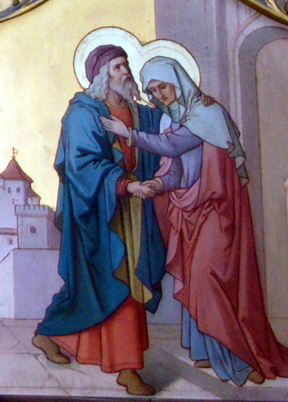 Before being favored with the greatest blessing ever bestowed on an earthly union, the two holy grandparents of the Word Made Flesh had to pass through the purification of suffering. Traditions which have come down to us from the very beginning of Christianity, tell us of these noble spouses subjected to the trial of prolonged sterility, and on that account despised by their people; of St. Joachim cast out of the temple and going to hide his sorrow in the desert; of St. Anne left alone to mourn her widowhood and humiliation.
Warned from Heaven to leave the desert, St. Joachim met his spouse at the golden gate which leads to the Temple on the east side. Not far from here, near the Probatica pool, where the little white lambs were washed before being offered in sacrifice, now stands the restored Basilica of St. Anne, originally called St. Mary of the Nativity. Here, as in a peaceful paradise, the rod of Jesse produced that blessed branch that had blossomed from eternity in the bosom of the Father. It is true that Sepphoris, St. Anne's native city, and Nazareth, where Mary lived, dispute with the Holy City the honor which ancient and constant tradition assigns to Jerusalem. But our homage will not be misdirected if we offer it today to Blessed Anne, in whom were wrought the prodigies, the very thought of which brings new joy to Heaven, rage to Satan, and triumph to the world.
St. Anne was, as it were, the starting point of Redemption, the horizon scanned by the prophets, the first span of the Heavens to be empurpled with the rising fires of dawn; the blessed soil whose produce was so pure as to make the Angels believe that Eden had been restored to us. But in the midst of the incomparable peace that surrounds her, let us hail her as the land of victory surpassing the most famous fields of battle; as the sanctuary of the Immaculate Conception, where our humiliated race took up the combat begun before the throne of God by the angelic hosts; where the serpent's head was crushed, and St. Michael, now surpassed in glory, gladly handed over to his sweet Queen, at the first moment of Her existence, the command of the Lord's armies.
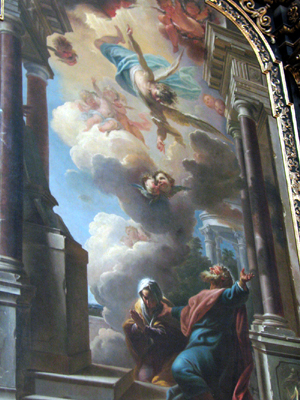 What human lips, unless touched like the prophet's with a burning coal, could tell the admiring wonder of the angelic Powers, when the Blessed Trinity, passing from the burning Seraphim to the lowest of the nine choirs, bade them turn their fiery glances and contemplate the flower of sanctity blossoming in the bosom of St. Anne? The Psalmist had said of the glorious City whose foundations were now hidden in Her that was once barren: The foundations thereof are in the holy mountains (Ps. 86: 1), and the heavenly hierarchies crowning the slopes of the eternal hills beheld in Her heights to them unknown and unattainable summits approaching so near to God, that He was even then preparing His throne in Her. Like Moses at the sight of the burning bush on Horeb, they were seized with a holy awe on recognizing the mountain of God in the midst of the desert of this world; and they understood that the affliction of Israel was soon to cease. Although shrouded by the cloud, Mary was already that blessed mountain whose base – i.e. the starting point of Her graces – was set far above the summits where the highest created sanctities are perfected in glory and love.
How justly is the mother named Anne, which signifies grace, she in whom for nine months were centered the complacencies of the Most High, the ecstasy of the angelic spirits, and the hope of all flesh! No doubt it was Mary, the daughter, and not the mother, whose sweetness so powerfully attracted the heavens to our lowly earth. But the perfume first scents the vessel which contains it, and, even after it is removed, leaves it impregnated with its fragrance. Moreover, it is customary to prepare the vase itself with the greatest care; it must be all pure, made of more precious material, and more richly adorned, according as the essence to be placed in it is rarer and more exquisite. Thus St. Mary Magdalene enclosed her precious spikenard in alabaster. The Holy Ghost, the Preparer of heavenly perfumes, would not be less careful than men. Now the task of Blessed Anne was not limited, like that of a material vase, to contain passively the treasure of the world. She furnished the body of Her who was to give flesh to the Son of God; she nourished Her with her milk; she gave to Her, who was inundated with floods of divine light, the first practical notions of life. In the part of a true Mother: not only did she guide Mary's first steps but she cooperated with the Holy Ghost in the education of Her soul and in the preparation of Her for Her incomparable destiny; until, when the work had reached the highest development to which she could bring it, she, without a moment's hesitation or a thought of self, offered her tenderly loved Child to Him from Whom she had received Her.
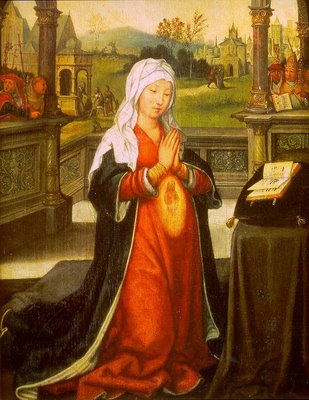 Sic fingit tabernaculum Deo – "Thus she frames a tabernacle for God." Such was the inscription around the figure of St. Anne instructing Mary, which formed the coat of arms of the ancient guild of joiners and cabinet-makers; for they, looking upon the making of tabernacles wherein God may dwell in our churches as their most choice work, had taken St. Anne for their patroness and model. Happy were those times when the simplicity of our fathers penetrated so deeply into the practical understanding of mysteries which their infatuated sons glory in ignoring. The valiant woman is praised in the Book of Proverbs for her spinning, weaving, sewing, embroidering, and household cares; naturally, then, those engaged in these occupations placed themselves under the protection of the spouse of St. Joachim. More than once, those suffering from the same trial which had inspired St. Anne's fervent prayer, experienced the power of her intercession in obtaining for others, as well as for herself, the blessing of our Lord God.
The East anticipated the West in the public devotion to the Grandmother of the Messias. Towards the middle of the 6th century a church was dedicated to her in Constantinople. The Typicon of St. Sabbas makes a liturgical commemoration of her three times in the year: on September 9, together with her spouse, St. Joachim, the day after the birthday of their glorious Daughter; on December 9, whereon the Greeks, a day later than the Latins, keep the Feast of Our Lady's Immaculate Conception, under a title which more directly expresses St. Anne's share in the mystery; and lastly, July 25, not being occupied by the Feast of St. James, which was kept on April 30 in their calendar, is called the Dormitio or precious death of St. Anne, mother of the Most Holy Mother of God: the very same expression which the Roman Martyrology adopted later.
Although Rome, with Her usual reserve, did not until much later authorize the introduction into the Latin Churches of a liturgical Feast of St. Anne, She nevertheless encouraged the piety of the faithful in this direction. As early as the time of St. Leo III (795-816) and by that illustrious Pontiff's express command, the history of St. Anne and St. Joachim was represented on the sacred ornaments of the noblest basilicas in the Eternal City. The Order of Carmel, so devout to St. Anne, powerfully contributed, by its fortunate migration into western Europe, to the growing increase of her devotion. Moreover, this development was the natural outcome of the progress of devotion among the people to the Mother of God. The close relation between the two devotions is noticed in a concession, whereby in 1381, Pope Urban VI satisfied the desires of the faithful in England by authorizing for that kingdom a Feast of St. Anne. The Church of Apt in Provence, France, had been already a century in possession of the Feast; a fact due to the honor bestowed on that Church of having received, almost together with the Faith, the Saint's holy body, in the first century of Christianity.
Since Our Lord, reigning in Heaven, has willed that His Blessed Mother should also be crowned there in Her virginal body, the relics of Mary's mother have become doubly dear to the world, first, as in the case of others, on account of the holiness of her whose precious remains they are, and then above all others, on account of their close connection with the mystery of the Incarnation. The Church of Apt was so generous out of its abundance, that it would now be impossible to enumerate the sanctuaries which have obtained, either from this principal source or from elsewhere, notable portions of these precious relics. We cannot omit to mention as one of these privileged places, the great Basilica of St. Paul outside the Walls: St. Anne herself, in an apparition to St. Bridget of Sweden, confirmed the authenticity of the arm which forms one of the most precious jewels in the rich treasury of that Church.
It was not until 1584 that Pope Gregory XIII ordered the celebration of the Feast on July 26 throughout the whole Church, with the rite of a double. Pope Leo XIII in 1879 raised it, together with that of St. Joachim, to the dignity of a solemnity of the II Class. But before that, Pope Gregory XV, after having been cured of a serious illness by St. Anne, had ranked her Feast among those of precept, with the obligation of resting from servile work.
 Now that St. Anne was receiving the homage due to her exalted dignity, she made haste to show her recognition of this more solemn tribute of praise. In the years 1623, 1624 and 1625, in the village of Kerouanne, near Auray, in Britanny, she appeared to Yves Nicolazic, and revealed to him an ancient statue buried in the field of Bocenno, which he tenanted. This discovery brought the people once more to the place where, a thousand years before, the inhabitants of ancient Armorica had honored that statue. Innumerable graces obtained on the spot spread its fame far beyond the limits of the Province, whose faith, worthy of past ages, had merited the favor of the grandmother of the Messias; and St. Anne d'Auray was soon so renowned as to be among the chief pilgrimage destinations of the Christian world.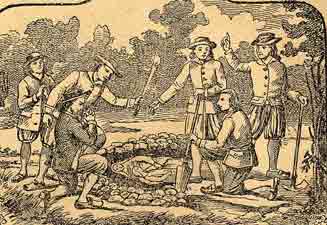
In the family circle, the grandmother's feast day is one of the most touching of all, when her grandchildren surround her with reverential love, as we gather around St. Anne today. Many do not know these beautiful feasts, where the blessing of the earthly paradise seems to revive in all its freshness; but the mercy of our God has provided a sweet compensation. He, the Most High God, willed to come so nigh to us as to be one of us in the flesh; to know the relations and mutual dependencies which are the law of our nature; the cords of Adam, with which He had determined to draw us and in which He first bound Himself. For in raising nature above itself, He did not eliminate it; He made grace take hold of it and lead it to Heaven; so that, joined together on earth by their Divine Author, nature and grace were to be united for all eternity. We then being brethren by grace of Him Who is ever the Grandson of St. Anne by nature, are, by this loving disposition of Divine Wisdom, quite at home under her roof; and today's Feast, so dear to the Hearts of Jesus and Mary, is our own family feast.
O Blessed Anne, rescue society, which is perishing for want of virtues like thine. Have pity on unhappy France, for which thou hast shown thy predilection, first, by so early confiding to it thy sacred body; later on, by choosing in it the spot whence thou wouldst manifest thyself to the world. O thou who lovest the Franks, continue to show fallen Gaul, once looked upon as the Kingdom of Mary, that love which is its most cherished tradition.
Back to "In this Issue"
Back to Top
Contact us: smr@salvemariaregina.info
Visit also: www.marienfried.com

