Saint John Nepomucene, Martyr († 1393; Feast – May 16)
To the Martyrs who were slain because they refused to adore false gods – to the Martyrs whose blood was shed by heretics – there is added today another brave soldier of Christ, who won his crown in a very different sort of combat. The Holy Sacrament of Penance, whereby sinners regain the Heaven they had lost, claims Saint John Nepomucene as its glorious defender.
A most holy secrecy shrouds the reconciliation made between God and the penitent. This sacramental secrecy deserved to have its very own Martyr. When Jesus instituted the Sacrament of Penance – that second "baptism," wherein the Blood of our Redeemer washes away the sins of the Christian soul – He willed that man should not be deterred from confessing his humiliations to his spiritual physician by the fear of their ever being revealed. How many hidden martyrdoms have there not been in the history of the Church for the maintenance of this secret, which, whilst it gives security to the penitent, exposes the confessor to calumny, injustice, and even death! But the Martyr we honor today was not one of these hidden sufferers. His testimony to the inviolability of the sacramental seal was public; he gave it amidst cruel tortures; it cost him his life.
All praise, then, to this brave and faithful priest! Right worthy was he to hold in his hands the keys that open or shut the gate of Heaven! In this great fact of the observance of the seal of confession, on which depends the salvation of millions of souls, we have a permanent miracle. But there was one thing wanting to it – the glory of martyrdom. The holy priest of Prague gave it that glory; and he offers the fair palm to our Risen Jesus, Whom we have seen, during the days between His Resurrection and Ascension, mercifully instituting the Sacrament of Penance, wherein He communicates to men His own power of forgiving sin.
We give here the Lessons approved by the Holy See for the Feast of this great Martyr:
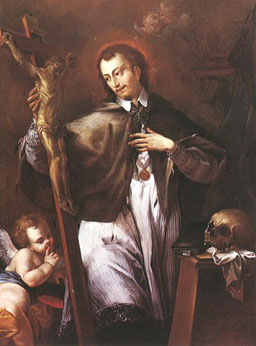 Saint John was born of parents who were advanced in years, at Nepomuk, a town of Bohemia, from which he took the name of Nepomucene. His future sanctity was foretold by the appearance of bright stars miraculously shining over the house wherein he was born. When an infant, he was siezed with a dangerous illness; but was delivered from death by the protection of the Blessed Virgin Mary, to Whom his parents considered themselves indebted for his birth. He was blessed with an excellent disposition, and received a pious training, in keeping with the indications given from Heaven. He spent his boyhood in the practice of religious exercises; it was his delight to be frequently in church and serve the priests at Mass. He went through the study of Humanities at Zatek and the higher studies at Prague, where he took his degrees in Philosophy, Theology and Canon Law. He was ordained priest; and being, by his proficiency in the science of the Saints, well fitted for gaining souls, he devoted himself entirely to preaching the word of God. In consideration of the great fruits produced by his eloquence and piety, which extirpated vice and brought sinners back to the way of salvation, he was made a Canon of the Metropolitan Church of Prague. Being afterwards chosen as preacher to King Wenceslaus IV, he so far succeeded, that the king had a great regard for his virtue, and often followed his advice. He offered him several dignities; but the Saint always refused to accept them, fearing that they would interfere with his preaching the Divine Word.
He was entrusted with the distribution of the royal alms to the poor, and Queen Joanna chose him as her own spiritual director. Wenceslaus, who had given himself up to vices, which disgraced his character both as a king and a Christian, was displeased at the entreaties and counsels of his wife, and even dared to insist on John's revealing to him the secrets, told to him as priest, by the Queen in the Sacrament of Penance. The minister of God courageously resisted the king's impious request, and neither bribes, nor tortures, nor imprisonment, could make him yield. Seeing that the king had reached such a pitch of rage that the laws of neither man nor God made him relent, the soldier of Christ plainly foretold in one of his sermons his own approaching death, and the calamities that were to befall the kingdom. He then set out for Buntzel, where is kept an image of the Blessed Virgin that has been venerated for centuries; he there implored Heaven in fervent prayer, to grant him the assistance he needed, in order to fight the good fight. As he was returning home, on the evening before the Vigil of the Ascension, the king, who was standing at the palace window, saw him, and sent word that he was to come to him. The king was more than ever urgent in his demand, and threatened John with immediate drowning, if he continued to refuse compliance. The Saint was not to be conquered, and showed the king that he was not afraid of his threats. Wherefore, by the king's orders, he was thrown that same night into the river Moldau, which flows through Prague; and thus obtained the glorious crown of martyrdom.
 The sacrilegious crime thus privately committed was miraculously revealed, as was also the great glory of the Martyr. For as soon as life was extinct, and the corpse began to float down the stream, flaming torches were seen following it on the surface of the water. The next morning, the Canons went and took the body from the sand on which it lay, and heedless of the king's displeasure, had it carried with much solemnity to the metropolitan Church, and gave it burial. The memory of this courageous priest became most venerated in the course of time both through the miracles that were wrought, and through the devotion of the faithful – especially of those whose good name has been injured by evil report. After upwards of 300 years, a juridical examination was made of his body (which, during all this time, had lain under the ground), and his tongue was found to be incorrupt and like that of a living man. Six years later the tongue was shown to judges delegated by the Aposotlic See; when, by a fresh miracle, it immediately resumed the freshness of life, and, from being of a brownish color, became perfectly red. These and other miracles having been authentically proved, he was canonized by Pope Benedict XIII, on the 19th day of March, in the year of Our Lord 1729, as the defender of the seal of confession, and the first Martyr to shed his blood for the maintenance of its holy secrecy.
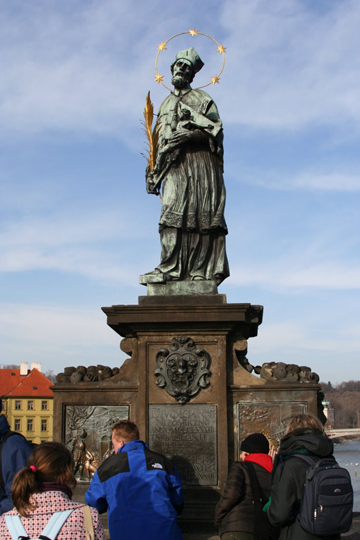
How great, O glorious Martyr, was the honor reserved for thee by the Son of God, when He chose thee to be the one who was to attest, by laying down his life, the sacredness of the secret which protects the Sacrament of Penance! Other priests, as well as thyself, have bravely suffered persecution for the sake of the secrecy of this Sacrament; but thou wast the one chosen by Heaven to give a solemn testimony of priestly discretion and fidelity. (Image at right – statues of St. John of Nepomucene adorn scores of bridges througout Bohemia and Germany.)
Intercede for all who let themselves be carried on to the deep abyss by the tide of their sinful habits and who turn a deaf ear to the invitation to approach this tribunal of mercy. Pray also for those who go to Confession, but who have not the dispositions requisite for receiving the grace of the Sacrament; pray that they may see the danger they thus incur of profaning the Blood of Christ. Obtain for all who approach the holy tribunal an honest avowal of their sins, and true contrition of heart; that thus the life of our Risen Jesus may be imparted to them and that they may never again lose it. By thy powerful intercession, raise up zealous and faithful ministers of this great Sacrament of which thou wast the Martyr. Draw down the blessing of Heaven on their arduous labor; then will the number of the children of God be increased, and the grace of the Holy Ghost triumph in souls that have long been dead in sin.
Cast, too, an eye of compassion on thy fatherland of Bohemia, where once there were so many faithful hearts who loved and honored thee. The enemy came, not many years after thy glorious martyrdom, and sowed the baneful weeds of heresy in thy native land. The good seed claims thy protection; but take pity also on the cockle, for even it may be turned, by the true Faith, into wheat, and be garnered into the House of our Heavenly Father. Amen.
Back to "In this Issue"
Back to Top
Back to Saints
Contact us: smr@salvemariaregina.info
Visit also: www.marienfried.com

