Fourth in a Series
Dr. Rudolf Graber, Bishop of Regensburg, Germany and
one of the "Council Fathers" of Vatican II, sent shockwaves around the world
when on May 2, 1973, the 1600th anniversary of the death of St. Athanasius, he issued a
short book entitled, Athanasius and the Church of Our Time. In this brief
work, Dr. Graber revealed the true roots of the Council and the "diabolical
plot" of the enemies of the Catholic Church to infiltrate her ranks and attempt to
destroy Her from within. The book has been largely ignored, but fortunately an
English translation was published.
Having exposed the plot of secret societies to
infiltrate the Church with the goal of having a "pope" and a "council"
to further their ends, Dr. Graber now turns the focus on Modernism:
Pius X and Modernism (excerpts)
Looking back on the 19th century one cannot help
noticing that the Church as a Whole took little notice of these goings-on. At the
First Vatican Council the Rock of St. Peter was so well cemented and shielded on all sides
that no storm could shake it – or so it was thought. Only one man's
perception went deeper, that of Pope St. Pius X, with whose struggle against Modernism we
must now deal with in greater detail...
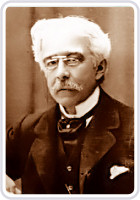 We shall now quote, as a flash-back to what we said about
the secret societies, the following passages from the novel Il Santo by Antonio
Fogazzaro (1842-1911; see image left – Fogazzaro, like Chardin, tried to mingle Catholicism with Darwinism), which was put on the Index of Forbidden Books soon after its
publication in 1905: "There are," says Don Paulo, "a number of us Catholics
both inside and outside Italy, clergymen and laymen, who are striving for a reform of the
Church. We wish to see this reform carried out without rebellion by the legitimate
authorities. We wish for reforms in the sphere of religious instruction and that of
worship, a reform of the discipline of the clergy, indeed even reforms in the supreme
regiment. Hence we must create a public opinion which will induce the legitimate
authorities to take steps accordingly even if this is not for 20, 30 or 50 years (!).
We who hold this opinion are, however, in reality individual persons living
isolated from each other. We know nothing of each other except for those few who
publish articles and books. There are probably a large number of religious and
highly educated people in the Catholic world who think like us. I thought it would
be beneficial for the propagation of our ideas for us at least to know each other.
This evening we are gathering here, only a few of us, for a first exploratory
discussion..." "He added, raising his voice and speaking more slowly
with his eyes fixed on Abbé Marinier, that he considered it advisable for the time being
not to disclose anything about the meeting or the decisions that had been made and he
requested all present to consider themselves bound on their word of honor to silence.
Then he developed his concept and the aim of this meeting again in somewhat greater
detail than over dinner."
We shall now quote, as a flash-back to what we said about
the secret societies, the following passages from the novel Il Santo by Antonio
Fogazzaro (1842-1911; see image left – Fogazzaro, like Chardin, tried to mingle Catholicism with Darwinism), which was put on the Index of Forbidden Books soon after its
publication in 1905: "There are," says Don Paulo, "a number of us Catholics
both inside and outside Italy, clergymen and laymen, who are striving for a reform of the
Church. We wish to see this reform carried out without rebellion by the legitimate
authorities. We wish for reforms in the sphere of religious instruction and that of
worship, a reform of the discipline of the clergy, indeed even reforms in the supreme
regiment. Hence we must create a public opinion which will induce the legitimate
authorities to take steps accordingly even if this is not for 20, 30 or 50 years (!).
We who hold this opinion are, however, in reality individual persons living
isolated from each other. We know nothing of each other except for those few who
publish articles and books. There are probably a large number of religious and
highly educated people in the Catholic world who think like us. I thought it would
be beneficial for the propagation of our ideas for us at least to know each other.
This evening we are gathering here, only a few of us, for a first exploratory
discussion..." "He added, raising his voice and speaking more slowly
with his eyes fixed on Abbé Marinier, that he considered it advisable for the time being
not to disclose anything about the meeting or the decisions that had been made and he
requested all present to consider themselves bound on their word of honor to silence.
Then he developed his concept and the aim of this meeting again in somewhat greater
detail than over dinner."
"We probably all agree that the
Catholic Church can be compared with an old temple which, originally of noble simplicity
and great religious spirituality, has been disfigured and overloaded with all kinds of
ornamentation and stucco-work during the course of the 17th, 18th and 19th centuries.
Perhaps the malevolent among you will remark that only a dead language is spoken
aloud in it, that the living languages are hardly spoken audibly at all, and that the
sunlight entering through the windows is colored. But I cannot believe that we all
agree as to the quality and quantity of the remedial measures. And I therefore hold it to
be more appropriate to come to an agreement on the nature of the reforms before proceeding
to the establishment of this Catholic Freemasonry. Indeed, I wish to go even
further. I believe that even if your ideas were in complete agreement, I should not
advise you to bind yourselves by a tangible bond... You confidently believe that
you can swim well under water like cautious fish and do not bear in mind that the sharp
eye of the exalted Fisherman or one of His representatives can very well detect you and
catch you..."
The aim, then, was a secret association of all those
with similar ideas, a Catholic Freemasonry, in the course of which a remark was made which
sounds almost prophetic: "The reforms will be carried out one day; ideas are stronger
than men and win through." They have won through in precisely 50 years. But the
other prophesy came true, too: the great Fisherman in Rome pulled the fish to the surface.
It was St. Pius X who gave voice to the condemnation of Modernism in His encyclical
Pascendi on September 8, 1907.
Let us now begin with a brief outline of the
contents of the encyclical. The Pope regrets that the Modernist errors "have
arisen in the lap of the Church and even amongst the clergy. These enemies of the
Church set themselves up as 'reformers of the Church' and with blasphemous
impudence debase the Divine Person of the Redeemer to a mere miserable human being."
The Modernists are therefore"worse than all other enemies of the Church"
because they "attack the root, the Faith and deepest fibers of the Faith. They are
extremely skillful and cunning." "They assume the role of the rationalist
and the Catholic in turn so skillfully that they find it easy to draw the guileless over
to their errors." They no longer acknowledge any authority and are unwilling "to
tolerate any further restriction. The Catholic Faith itself is in jeopardy. It
would be a sin to remain silent any longer. We must speak out, we must unmask them
in front of the whole Church."
After this spirited introduction the Pope takes up
the errors individually. Since according to the Modernists God is not revealed in
visible phenomena, the so-called motives of credibility are discarded – they
are hardly ever mentioned today either. As far as history is concerned it would have
to be explained "as if God had not in fact intervened." Hence it is also
necessary "to eliminate everything which seems to be Divine" from the history of
Christ, too. "There are Catholics, there are even a number of priests, who
publicly profess this and imagine they can renew the Church with such madness. It is
certainly impossible to do away with all supernatural order more thoroughly than
this." As far as dogmas as a whole are concerned "they are merely
inadequate signs... symbols" which in no way "embrace the Truth
absolutely." They are subject to "change" and are "necessarily
variable and short-lived." "In order to be vigorous they must continually
be accommodated to an equal degree to both the Faith and the Faithful."
The Pope concludes this section with the sharp
words: "In the frenzy of their conceited conviction that they know so much, these
blind leading the blind have even turned upside down the eternally true concepts of truth
and religion; they have founded a new system and in their wild, unbridled chase after new
ideas they have forgotten to seek the truth where it dwells in safety; holy, apostolic
traditions are scorned and in their place other doctrines resorted to which are idle and
empty and uncertain, and which do not possess the sanction of the Church; and with such
things they believe, in their delusion, that they can uphold and preserve truth
itself."
We should be surprised if it had not already been
maintained at that time that "all religions are true." The same is true of
the question of "whether Christ really performed miracles, really prophesied future
events, whether He really rose from the dead and ascended into Heaven." Just as
is done today, God was already transferred into man at that time: "God is immanent in
man." Like the dogmas mentioned above, the sacraments, too, are "mere
symbols and signs." At this point the Pope inserts a remark which could have
been written today: "In order to exemplify how they work, certain slogans can be
pointed out, which, to use the common expression, 'draw' because they possess
great appeal as propaganda for powerful and exciting ideas."
(To be continued in future issues.)
Back to "In this Issue"
Back to Top
Contact us: smr@salvemariaregina.info
Visit also: www.marienfried.com

