The Traditional Catholic Liturgy
Adapted from The Liturgical Year by Abbot Gueranger
The Holy Name of Mary—September 12
"And the Virgin's name was Mary. Let us speak a little about this name, which signifies star of the sea, and which so well befits the Virgin Mother. Rightly is She likened to a star; for as a star emits its ray without being dimmed, so the Virgin brought forth Her Son without receiving any injury – the ray takes nothing from the brightness of the star, nor the Son from His Mother's integrity. This is the noble star risen out of Jacob, whose ray illumines the whole earth, gives warmth rather to souls than to bodies, cherishing virtues, withering vices. Mary, I say, is that bright and incomparable star, whom we need to see raised above this vast sea, shining by Her merits, and giving us light by Her example.
Oh! whosoever thou art that seest thyself, amid the tides of this world, tossed about by storms and tempests rather than walking on the land, turn not thine eyes away from the shining of this star if thou wouldst not be overwhelmed by the hurricane. If squalls of temptations arise, or thou fall upon the rocks of tribulation, look to the star, call upon Mary. If thou art tossed by the waves of pride or ambition, detraction or envy, look to the star, call upon Mary. If anger or avarice or the desires of the flesh dash against the ship of thy soul, turn thine eyes towards Mary. If, troubled by the enormity of thy crimes, ashamed of thy guilty conscience, terrified by dread of the judgment, thou beginnest to sink into the gulf of sadness or the abyss of despair, think of Mary. In dangers, in anguish, in doubt, think of Mary, call upon Mary. Let Her be ever on thy lips, ever in thy heart; and the better to obtain the help of Her prayers, imitate the example of Her life. Following Her, thou strayest not; invoking Her, thou despairest not; thinking of Her, thou wanderest not; upheld by Her, thou fallest not; shielded by Her, thou fearest not; guided by Her, thou growest not weary; favored by Her, thou reachest the goal. And thus dost thou experience in thyself how good is that saying: And the Virgin's name was Mary." (Matins of the Feast)
Thus speaks the devout St. Bernard, in the name of the Church. But his pious explanation does not exhaust the meanings of the Blessed Name of Mary. St. Peter Chrysologus adds in this same night Office: "Mary in Hebrew signifies lady or sovereign: and truly the authority of Her Son, Who is the Lord of the world, constituted Her Queen, both in fact and in name, from Her very birth."
Our Lady: such is the title which befits Her in every way, as that of Our Lord befits Her Son; it is the doctrinal basis of that worship of hyperdulia which belongs to Her alone. She is below Her Son, Whom She adores as we do; but above all God's servants, both Angels and men, inasmuch as She is His Mother. At the Name of Jesus every knee is bent; at the Name of Mary every head is bowed. And although the former is the only Name whereby we may be saved; yet, as the Son can never be separated from His Mother, Heaven unites their two Names in its hymns of praise, earth in its confidence, Hell in its fear and hatred.
It was therefore in the order of Divine Providence that devotion to the Most Holy Name of Mary should spread simultaneously with the worship of the adorable Name of Jesus, of which St. Bernardine of Siena was the apostle in the 15th century. In 1513 the Church of Cuenca in Spain was the first to celebrate, with the approbation of the Holy See, a special feast in honor of the Name of Mary, while the Franciscan Order had not yet succeeded in obtaining a like privilege for the adorable Name of Jesus. The reason of this is that the memorial of that Sacred Name, which is included in the Feast of the Circumcision, seemed to the prudence of the Popes to suffice. From the same motive we find the Feast of the Most Holy Name of Mary extended to the Universal Church in the year 1683, and that of the Most Holy Name of Jesus not until 1721.
"Who is She that cometh forth as the morning rising, fair as the moon, bright as the sun, terrible as an army set in array?" (Cant. 6: 9) Such is Thy growth, O Mary! Not the holiest life, were it even of patriarchal duration, will ever attain the degree of progress made under the influence of the Divine Power by the soul of the Most Pure Virgin, in these few days elapsed since Her coming on earth (September 8). First, there is progress of Her intellect: not subject to the obscurity which envelopes the minds of all men at their entrance into the world, it is a faithful mirror, into which the Word of God pours floods of light which is also life. Then the progress of love in that Heart of the Virgin and the Mother, wherein the Holy Ghost already delights to awake such ineffable harmonies, and to dig still deeper depths. Lastly, the progress of that victorious power, which made Satan tremble at the moment of the Immaculate Conception, and which has constituted Mary the incomparable Queen of the hosts of the Lord.
Two glorious triumphs, two victories won under the protection of Our Lady, have rendered September 12th illustrious in the annals of the Church and of history.
Manicheism, revived under a variety of names, had established itself in the south of France, whence it hoped to spread its reign of shameless excess. But St. Dominic appeared with Mary's Rosary for the defense of the people. On September 12, 1213, Simon de Montfort and the crusaders of the Faith, though outnumbered 40 to 1, crushed the Albigensian army at Muret. This was in the pontificate of Innocent III.
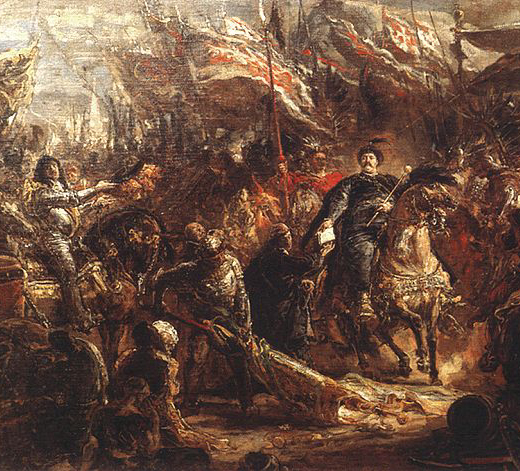 Nearly five centuries later, the Turks, who had more than once caused the West to tremble, again poured down upon Christendom. Vienna, worn out and dismantled, abandoned by its emperor, was surrounded by 300,000 infidels. But another great Pope, Innocent XI, again confided to Mary the defense of the baptized nations. General Sobieski, mounting his charger on the Feast of Our Lady's Assumption, hastened from Poland by forced marches. On the Sunday within the Octave of the Nativity of Mary, September 12, 1683, Vienna was delivered; and then began for Turks that series of defeats which ended in the treaties of Carlowitz and Passarowitz, and the dismemberment of the Ottoman Empire. The Feast of the Most Holy Name of Mary, inscribed on the calendar of the Universal Church, was the homage of the world's gratitude to Mary, Our Lady and Queen.
The date of the Feast came to be fixed on September 12, although originally it was celebrated, in most places, on the Sunday within the Octave – a day which also corresponded to Sobieski's victory. The Church of Milan used to celebrate it on September 11, and had a beautiful proper Preface, so perfectly in harmony with the sentiments inspired by this bright Feast:
It is truly meet to give Thee thanks, O eternal God, Who didst will that the Most Blessed Virgin Mary should be the Mother of Thine Only-Begotten Son: for it was not fitting that God's Mother should be other than a Virgin, nor that the Virgin's Son should be other than God. As at the Name of Jesus, every knee in Heaven, on earth, and in Hell bends before Thy Divine Majesty; so on hearing the Name of Mary, the Heavens bow down, earth prostrates, Hell trembles, confessing Thine adorable Omnipotence in the Virgin-Mother. And therefore with Angels and Archangels, with Thrones and Dominations, and with all the hosts of the Heavenly Army, we sing the hymn of Thy glory, evermore saying: Holy, Holy, Holy Lord God of Host! Heaven and earth are full of Thy glory! Hosanna in the highest…!
Back to "In this Issue"
Back to Top
Contact us: smr@salvemariaregina.info
Visit also: www.marienfried.com

