The Traditional Catholic Liturgy
Adapted from The Liturgical Year by Abbot Gueranger
Practice During Paschal Time
The practice for this holy season mainly consists in the spiritual joy which it should produce in every soul that is risen with Jesus. This joy is a foretaste of eternal happiness, and the Christian ought to consider it a duty to keep it up within him, by ardently seeking after that life which is in our Divine Head, and by carefully shunning sin which causes death. During the last 9 weeks we have mourned for our sins and done penance for them; we have followed Jesus to Calvary; but now, our Holy Mother the Church is urgent in bidding us rejoice. She Herself has laid aside all sorrow; the voice of Her weeping is changed into the song of a delighted Spouse. The great liturgist of the 12th century, Rupert, Abbot of Deutz, thus speaks of the pious artifice used by the Church to infuse the spirit of Easter into all: "There are certain carnal minds that seem unable to open their eyes to spiritual things, unless roused by some unusual excitement; and for this reason the Church makes use of such means. Thus, the Lenten fast, which we offer up to God as our yearly tithe, goes on till the most sacred night of Easter; then follow 50 days without so much as one single fast. Hence...that holy night is eagerly looked forward to even by the carnal-minded… Thus the sacred solemnity is sweet to all, dear to all, and desired by all, as light is to them that walk in darkness, as a fount of living water is to them that thirst, and as a tent which the Lord hath pitched for wearied wayfarers."
What a happy time it was when, as St. Bernard expresses it, there was not one in the whole Christian army that neglected his Easter duty, and when all, both just and sinners, walked together in the path of the Lenten observances! Alas! those days are gone, and Easter has not the same effect on the people of our generation! The reason is that a love of ease and a false conscience lead so many "Christians" to treat the law of Lent with as much indifference as if there were no such law existing. Hence, Easter comes upon them as a feast – it may be a great feast – but that is all; they experience little of that thrilling joy which fills the heart of the Church during this season, and which She evinces in everything She does. And if this be their case even on the glorious day itself, how can it be expected that they should keep up, for the whole 50, the spirit of gladness, which is the very essence of Easter? They have not observed the fast or the abstinence of Lent: the mitigated form in which the Church now presents them to her children, in consideration of their weakness, was too severe for them! They excused themselves from Lenten mortification without regret or remorse. The Alleluia returns, and it finds no response in their souls: how could it? Penance has not done its work of purification; it has not spiritualized them; how then could they follow their Risen Jesus, Whose life is henceforth more of Heaven than of earth?
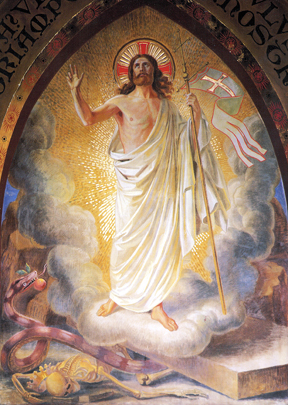 But these reflections are too sad for such a season as this: let us beseech our risen Jesus to enlighten these souls with the rays of His victory over the world and the flesh, and to raise them up to Himself. No, nothing can distract us from joy. "Can the children of the Bridegroom mourn, as long as the Bridegroom is with them?" (Matt. 9: 15) Jesus is to be with us for 40 days; He is to suffer no more, and die no more; let our feelings be in keeping with His now endless glory and bliss. True, He is to leave us, He is to ascend to the right hand of His Father; but He will not leave us orphans; He will send us the divine Comforter, who will abide with us forever. These sweet and consoling words must be our Easter text: "The children of the Bridegroom cannot mourn, as long as the Bridegroom is with them." They are the key to the whole Liturgy of this Holy Season. We must have them ever before us, and we shall find by experience that the joy of Easter is as salutary as the contrition and penance of Lent.
But this Easter of ours will have an end; the bright vision of our Risen Jesus will pass away; and all that will be left to us is the recollection of His ineffable glory, and of the wonderful familiarity wherewith He treated us. What shall we do, when He Who was our very life and light leaves us and ascends to Heaven? Be of good heart, Christians! You must look forward to another Easter. Each year will give you a repetition of what you now enjoy. Easter will follow Easter, and bring you at last to that Easter in Heaven which is never to have an end, and of which these happy ones of earth are a mere foretaste. Nor is this all. Listen to the Church. In one of Her prayers She reveals to us the great secret, how we may perpetuate our Easters even here in our banishment – "Grant to Thy servants, O God, that they may keep up, by their manner of living, the Mystery they have received by believing" (Collect for Tuesday in Easter Week). So then, the Mystery of Easter is to be ever visible on this earth; our Risen Jesus ascends to Heaven, but He leaves upon us the impress of His Resurrection, and we must retain it within us until He again visits us.
And how could it be that we should not retain this divine impress within us? Are not all the mysteries of our Divine Master ours also? From His very first coming in the Flesh, He has made us sharers in everything He has done. He was born in Bethlehem: we were born together with Him. He was crucified: our "old man was crucified with Him" (Rom. 6: 6). He was buried: "we were buried with Him" (Rom 6: 4). And therefore, when He rose from the grave, we also received the grace that we should "walk in the newness of life" (Ibid.) To die again by sin would be to renounce Him, to separate ourselves from Him, to forfeit that Death and Resurrection of His which He mercifully willed should be ours. Let us therefore preserve within us that life, which is the life of our Jesus, and which yet belongs to us as our own treasure.
Back to "In this Issue"
Back to Top
Contact us: smr@salvemariaregina.info
Visit also: www.marienfried.com

