|
Vol. 41, Issue No. 113 |
St. Ignatius of Loyola, Knight of Mary
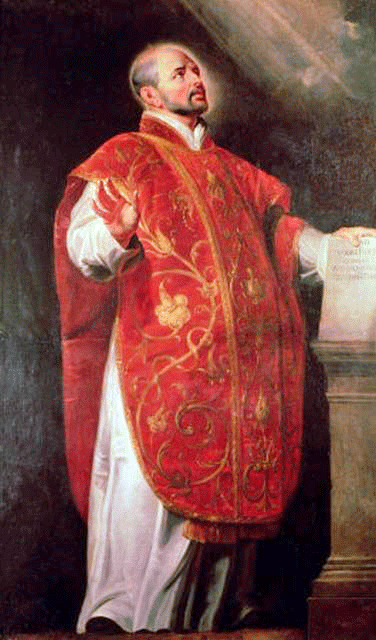 When, during the fifteenth century, the leaders of the Protestant revolt began to "reform" God's revealed Religion, Divine Providence chose a young soldier to help save and rebuild the Church of Christ: a young Spanish nobleman named Iigo de Loyola. And, as we shall see in significant excerpts from his autobiography, this extraordinary man, who became the Founder and Commander-in-chief of the vast army of well-trained soldiers of God known as the Society of Jesus, was converted in only one year by the Blessed Virgin herself from a very worldly life to one of heroic sanctity.
A few months before he died, St. Ignatius dictated to a friend, in the third person, an account of his youth and conversion, in which he admitted that "up to his twenty-sixth year, his heart was fascinated by the vanities of the world. His special delight was in the military life, and he seemed to be led by a strong and empty desire of making a great name for himself."
As a youth, Ignatius was proud and ambitious, a great reader of tales of chivalry, and quite vain. While attached to the service of a nobleman, he always bore arms and wore an open cloak. He was very overly fastidious about his appearance, took much care of his delicate hands and long hair, and always dressed according to the latest worldly fashions.
At this time, according to one of his closest friends, "he did not live in harmony with his holy Faith, and did not keep himself from sin. He was particularly prone to gambling, duels, and other vices common to his worldly inclinations." Once Ignatius and one of his brothers were arrested for some unspecified escapade, perpetrated at night, which had caused considerable damage. That he was a typically hot-blooded Spaniard is proven by the fact that one day, when some men on a street happened to crowd him to the wall, Ignatius drew his sword and pursued them, and "if he had not been held back, it would have ended in a murder", according to an eye-witness.
But He was also a loyal patriot and a fearless soldier. When the French invaded his country, during the month of Our Lady in the year 1521, Ignatius confessed his sins in the chapel of Our Lady, and then bravely fought off a six-hours siege, until a cannonball struck his legs, breaking one and wounding the other. Soon after he fell, his troops surrendered.
Despite his extremely painful wounds, he was carried to the Loyola family home on a stretcher. The doctors then decided to break his leg again in order to reset it correctly. During this "butchery", as Ignatius called it, he stoically gave no sign of suffering, except for tightly clenching his fists. But soon he lost strength and could not eat. On the Feast of St. John the Baptist (June 24) the doctors gave up hope for his recovery and advised him to make his last Confession. And on the Feast of Sts. Peter and Paul he received the Last Sacraments, for the doctors expected him to die that night.
But Christ the King had other plans for His future soldier. As Ignatius put it, "He was already devoted to St. Peter" (the Patron Saint of the Loyola family), "and therefore it pleased Our Lord that that very night he began to get better, and within a few days he was considered out of danger." But the worldly young Spaniard was not yet converted, for when he saw that one leg was deformed and shorter than the other, "out of vanity, because he still wanted to spend his life at court", he willingly underwent a still more painful operation which involved the sawing off of a protruding bone, after which he had to stay in bed for many weeks while the wound healed.
To pass the long hours, Ignatius asked for some of the worldly books and romance novels which he liked. But, by God's design, his devout sister saw to it that the only reading material available to him was a "Life of Christ" and a book on the "Lives of the Saints." Now the future Saint himself will tell us the striking story of his conversion:
"By frequently reading these books he began to acquire some love for spiritual things. This reading led his mind to meditate on holy subjects, yet sometimes it wandered to thoughts which he had been accustomed to dwell on before. While going through the life of Our Lord and the Saints, he began to reflect and say to himself: 'What if I should do what St. Francis did? What if I should act like St. Dominic? St. Francis did this-therefore I will do it too!' These heroic resolutions remained for a time, and then other vain and worldly thoughts followed. But in these thoughts there was this difference: when he thought of worldly things it gave him great pleasure, but afterwards he found himself dry and sad; but when he thought of journeying to Jerusalem and of living only on herbs and practicing austerities, he found pleasure not only while thinking of them, but also when he had ceased.
"By experience he learned that one train of thought left him sad, the other joyful. This was his first discovery in spiritual matters. When gradually he recognized the different spirits by which he was moved-one of the Spirit of God, the other the Devil-and when he had gained considerable spiritual enlightenment from reading religious books, he began to think more seriously of his past life and how much penance he should do to expiate his past sins. The holy desire to imitate saintly men came to his mind. His resolve was not more definite than to promise that, with the help of Divine grace, he too would do what they had done. His one wish after his recovery was to make a pil grimage to Jerusalem. He fasted frequently and scourged himself to satisfy the desire for penance which ruled a soul filled with the spirit of God. The vain thoughts gradually decreased."
Then, during the glorious Feast of Our Lady's Assumption, there occurred that decisive intervention of the Blessed Virgin Mary which permanently changed the worldly young Spanish soldier into a great and fervent and pure saint of God.
One night, while Ignatius was praying, "he distinctly saw the Blessed Mother of God with the Holy Infant Jesus! And at this sight, for quite some time, he was overwhelmed with consolation. And he remained with such disgust for his whole past life, and especially for impurity, that it seemed to him as if all the impressions which had hitherto been imprinted on his soul were torn away." From that moment until the end of his life, "he never again gave the least consent to impure sin. Consequently, the experience may be considered as having been from God.
Henceforth "his brother and all in the house noticed from his appearance what a great change had taken place in his soul. Meanwhile, he continued his reading and kept the holy resolution he had made. At home, his conversation was wholly devoted to Divine matters and had a spiritual influence on others." He proceeded to make an intensive study of the Gospels. and to write out all their most important passages in a notebook. Thus he reverently filled three hundred pages, using red ink for Christ's words, and blue ink for those of Mary. As soon as he could get up, he spent much of his time in the Chapel of the Annunciation in his home. Now he also "began his habit of taking the discipline every night. During these days his greatest source of consolation was to gaze at the heavens and stars at night, which he did frequently and for a long time, experiencing in his soul a very generous impulse to serve Our Lord." And he seriously considered becoming a Carthusian monk after his pilgrimage to the Holy Land.
As soon as his health permitted, he left home, taking with him a picture of our Sorrowful Mother; a prayer book containing the Little Office of the Blessed Virgin Mary, and his notebook of the Gospels. Setting out on his pilgrimage, and at the same time on his new life, Ignatius went immediately to the nearest shrine of Our Lady, and spent the night there in prayer; thanking his Queen for his conversion, praying for strength for his journey, and receiving such stirring consolations that thirty years later he still spoke of them with intense gratitude.
Traveling on, he collected some money owed to him, and spent half of it on the restoration of a picture of the Blessed Virgin Mary in a church on the way. And it was probably at this time that he solemnly made, before God and through the mediation of Our Lady, a private vow of perpetual chastity.
Yet, as he admitted later, "his knowledge of spiritual things was still very obscure. To do something great for the glory of his God, to imitate saintly men in all they had done before him-this was his only object in his practice of external mortification." Yet his love for Our Lady and his zeal for spiritual progress caused him to grow daily in virtue.
His noble upbringing and chivalrous spirit lent a remarkable character to his tender love for his Lady, the Immaculate Queen of the Universe, and gave him a truly admirable intolerance for the least offence against her virtue and dignity. Once, a Moslem, riding his donkey along the way with Ignatius for a while, insisted, despite all argument, that the Mother of Christ could not have remained a perpetual virgin after the Birth of her Divine Son. Ignatius gave vent to such outrage at the unspeakable blasphemy of this obstinate infidel that both his horse and the Moslem's donkey were terrified at his mighty roar, and bolted. As Ignatius was "sorely troubled and feeling impelled by a strong impulse to hasten after him and kill him", the animal's flight saved the infidel's life. As for Ignatius, he resolved to settle all his doubts in the following novel way: if on coming to the next crossroad his horse followed the infidel, he would pursue him and kill him. "Through the Providence of God" the horse took the other direction, and Ignatius decided that, in this instance at least, God "desired not the death of the sinner, but that he be converted and live." This is a glimpse of the totally Catholic outlook, intolerant of error and heresy, an expression of true love of God, which would become the hallmark of Ignatius' forthcoming battle campaign for the salvation of souls.
Next he went to the famous ancient Shrine of Our Lady of Montserrat in order to spend an entire night in prayer before her altar and thus, like the knights of chivalry, to become one of her soldiers by taking up the arms of Christ. And on the eve of the Feast of the Annunciation, 1522, after a general confession that lasted three days, the twenty-nine year-old Ignatius Loyola, dressed only in a piece of sackcloth "filled with prickly wooden fibers... hastened at nightfall to the church, where he threw himself on his knees before the altar of the Blessed Mother of God, and there, now kneeling, now standing, with staff in hand, he passed the entire night. After receiving the Blessed Sacrament, he left the town at daybreak."
Ignatius now went to a small nearby town named Manresa, which was situated in a lovely valley and which had a Cathedral and eleven other churches dedicated to the Mother of God. Here the holy knight of Mary begged alms for his living and spent most of his time in the hospital and the churches. He also taught catechism to children and began to speak about religion to all who associated with him. Here too, he underwent various spiritual trials and mystical experiences. He went to Confession and Holy Communion once a week, and during Mass every day he read the Passion in one of the Gospels, which filled his soul "with a joyful feeling of uninterrupted calm." He often spent hours meditating in a lonely cave outside the town, which has now become the famous Shrine of Manresa. He lived in a Dominican monastery, and "kept up his usual custom of praying on bended knees for seven hours a day, and scourged himself three times a day and during the night.
During this extraordinary novitiate, Mary's soldier, no doubt through her intercession, received numerous heavenly favors. "Once while reciting on the steps of the monastery the Little Hours in honor of the Blessed Virgin, his vision carried him beyond the earth. He seemed to see the Holy Trinity, and this vision affected him so much that he could not keep from weeping and sobbing. During the rest of his life, whenever he prayed to the Holy Trinity, he experienced great devotion."
"Often in prayer, and for a long time, he saw with the eyes of his soul Our Lord and His Humanity... perhaps twenty or even forty times. He saw the Blessed Virgin Mary likewise. These visions gave him such strength that he often thought that even if Holy Scripture did not bear witness to these mysteries of the Faith, still, from what he had seen, it would be his duty to lay down his life for them."
It was during his stay of ten months at Manresa that St. Ignatius wrote the first draft of his famous Spiritual Exercises; a series of systematically graded examinations of conscience and meditations on the life of Christ, designed for a thirty-days' retreat, which have in thousands of cases converted retreatants—including many well-known priests and lay apostles—to a new life of loving, selfless service to Christ. While Jesus and Mary may not have literally dictated these powerful Spiritual Exercises to the Saint, it is certain that they did directly or indirectly inspire him to write them.
Such was the thorough ascetical and mystical training which the Blessed Virgin Mary gave to her chosen soldier before sending him out into the world in order, not unlike St. Francis of Assisi, to rebuild the Church of Christ.
After a pilgrimage to the Holy Land, Ignatius studied for the priesthood in Spain and at Paris, where he gathered around him a small group of outstanding followers like the future St. Francis Xavier. Later in Rome they founded the illustrious Society of Jesus, which for several centuries generously gave to Holy Mother Church hundreds of saintly scholars, educators, and missionaries, such as St. Peter Kanisus, St. John Francis Regis, St. Aloysius Gonzaga, and the North American Martyrs.
To Mary's soldier, St. Ignatius Loyola, perhaps more than to any other saint in his time, belongs the glory of having taken up the blood-stained banner of Christ, and valiantly led the charge against the raging enemies who would fain have destroyed His One, True Church by their Protestant Revolution. His uncompromising zeal for holiness was matched only by his unshakable fidelity to the Church and to the Holy Father, to Whom he bound all of his sons by a unique vow of instant and total obedience, as to the "Commander-in-chief" in the battle against the enemies of God. May St. Ignatius intercede for us to imitate his loyalty to the Church and Her legitimate authority in our time, when once again, She is being attacked by powerful enemies who are determined to destroy Her.
Visit also: www.marienfried.com
