
|
OUR LADY OF FATIMA CRUSADER BULLETIN |
Vol. 38, Issue No. 95 |
| Two Great Battles |
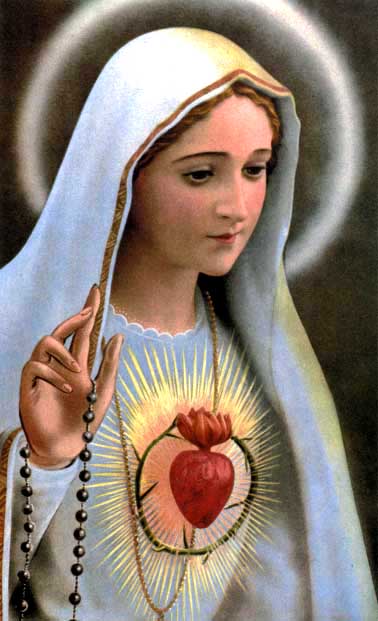 "I am the Lady of the Rosary..."
In this manner did the Mother of God identify herself to the shepherd children of Fatima. Repeatedly during Our Lady's series of apparitions to the children, she exhorted the praying of the daily Rosary. And even more, "to pray the Rosary well," with meditation on the mysteries. The Queen of Heaven held out the Rosary to mankind as a means of obtaining the salvation of souls, the conversion of sinners, true world peace, and the conversion of Russia. Less than a century before the apparitions at Fatima, Our Blessed Mother appeared to the girl Bernadette Soubirous at Lourdes, France. Here, too, she held the Rosary in her hands and exhorted the saintly child (and all mankind) to pray it, fervently and devoutly. The magnificent Fifteen Promises of Our Lady to those who faithfully pray the Rosary are certainly known to every truly devout Christian. If Heaven so highly favors this prayer, then why are the Modernist clergy and religious of our age so sadly neglecting it? Nay, even worse, in some instances they go so far as to ridicule it. Such blasphemy by the proud Pharisees of our day! No wonder the world and the Church are rent asunder by confusion, rebellion, and division. Let us, as devout Christians and faithful disciples of Jesus and Mary pay no heed to the modernist scoffers, but let us rather do all we can to point out how highly the Church values this spiritual treasure -- THE MOST HOLY ROSARY OF THE BLESSED VIRGIN MARY.
The Holy Father, Pope Leo XIII, wrote an encyclical on the Rosary each year of his pontificate. It was this great Pope who condemned the liberal heresies of his day and pointed out the Rosary as an antidote to the spread of heresy and of evil. He describes it thus:
"Very admirable is this crown interwoven with the angelic salutation, with which is interposed the Lord's Prayer, and which unites with it the obligation of interior meditation. It is an excellent manner of praying...and very efficacious for the attainment of immortal life." Commenting further on its efficacy, His Holiness proclaimed in his encyclical SUPREMI APOSTOLATUS, referring to the Rosary: "This devotion, so great and so confident, to the august Queen of Heaven has never shone forth with such brilliancy as when the militant Church of God has seemed to be endangered by the violence of heresy spread abroad, or by an intolerable moral corruption, or by the attacks of powerful enemies. Ancient and modern history and the more sacred annals of the Church bear witness to public and private supplications addressed to the Mother of God, to the help she has granted in return and to the peace and tranquility which she has obtained from God. Hence her illustrious titles of helper, consoler, mighty in war, victorious, and peace-giver. And among these is specially to be commemorated that familiar title derived from the Rosary, by which the signal benefits she has gained for the whole of Christendom have been solemnly perpetuated. There are none among you, Venerable Brethren, who will not remember how great trouble and grief God's Holy Church suffered from the Albigensian heretics, who sprang from the sect of the later Manicheans, and who filled the south of France and other portions of the Latin world with their pernicious errors, and carrying everywhere the terror of their arms, strove far and wide to rule by massacre and ruin. Our merciful God, as you know, raised up against these most direful enemies a most holy man, the illustrious parent and founder of the Dominican Order. Great in the integrity of his doctrine, in his example of virtue, and by his apostolic labors, he proceeded undauntedly to attack the enemies of the Catholic Church, not by the force of arms, but trusting wholly to that devotion which he was the first to institute under the name of the Holy Rosary, which was disseminated through the length and breadth of the earth by him and his pupils. Guided, in fact, by Divine inspiration and grace, he foresaw that this devotion, like a most powerful warlike weapon, would be the means of putting the enemy to flight, and of confounding their audacity and mad impiety. Such was indeed its result. Thanks to this new method of prayer -- when adopted and properly carried out as instituted by the holy father St. Dominic -- piety, faith, and union began to return, and the projects and devices of the heretics to fall to pieces. Many wanderers also returned to the way of Salvation, and the wrath of the impious was restrained by the arms of those Catholics who had determined to repel their violence. Our need of Divine help is as great today as when the great Dominic introduced the use of the Rosary of Mary as a balm for the wounds of his contemporaries."
Surely, these last-quoted words of His Holiness apply to our own age as never before. Let us go forth with the Divine weapon of the most holy Rosary to vanquish the Modernist heresy, pernicious error, and materialist corruption which are fast enveloping all of mankind.
Come, join with us in the most important crusade of our perilous age! Help us to overcome the impending darkness which threatens to engulf us all --- enlist today in the army of the Queen of Heaven as a CRUSADER OF THE MOST HOLY ROSARY.
"Show again thy power, with the signs which accompanied thy victories of old..."
Two great battles bear especially magnificent testimony to the power of the Blessed Virgin Mary over the legions of Hell and their human instruments.
In June of 1456, the Ottoman Sultan, Mohammed "the Conqueror", with an army of 150,000, laid siege to the city of Belgrade, the last Christian outpost before Europe would be laid bare to the Moslems. Pope Callistus III, the fiery Spanish Borgia whose people had been fighting Islam for over 700 years, placed his trust in God and in the Blessed Virgin Mary. To Hungary, he sent three Johns, in the Name of God and of Our Lady. St. John Capistrano, the diminutive Franciscan Friar, preached fervently in the towns and villages as he went, stirring the hearts and souls of the Christian people, young and old alike, until they rose up with devotion and zeal to fight in defense of Christ and His Church. John Hunyadi, the fearless Hungarian leader, raised a tiny army of 7,000 at his own expense, while a Prince of the Church, Cardinal John Carvajal, labored to quickly organize provisions and transport for this poorly equipped but ardently inspired Crusade.
The Battle of Belgrade was joined on July 14, and for five hours it raged furiously, as St. John Capistrano stood on the mountain above, his arms uplifted in prayer, bearing the Papal Crucifix, imploring the assistance of Our Lady. The Christian forces miraculously broke through to the city with supplies and food for the people. On July 21, they again streamed forth from the fortified walls to attack the Turks against incredible odds, as the Papal Crucifix was again uplifted for Divine assistance. Suddenly, the Sultan himself was wounded by a Christian arrow, and insane with pain and rage, he ordered a complete retreat. In thanksgiving for this victory, Pope Callistus established the Feast of the Transfiguration on August 6.
In 1571, the Moslems again threatened Europe as "Selim the Sot came to the throne of the Ottoman, and St. Pius V to the throne of Peter." The Holy Father ordered fervent prayers to the Blessed Virgin Mary, a veritable "Rosary Crusade", as he gathered the forces of Spain, Venice, Genoa, Malta, and his own tiny Papal fleet. On October 7, the Christian forces met the vastly superior Turkish armada in the Gulf of Corinth, close to Lepanto. Flying the banner of Christ Crucified, given to him by the Pope, and under the standard of Our Lady of Guadalupe, Don Juan of Austria led his fervent Catholic host to victory, losing 7,500 men to almost 30,000 Turkish dead. But it was clear to all that "neither valor, nor arms, nor leaders gave the victory, but the Rosary of Our Lady." In thanksgiving for the victory of Lepanto, Pope Gregory XIII established the Feast of the Holy Rosary on October 7th.
Visit also: www.marienfried.com
