
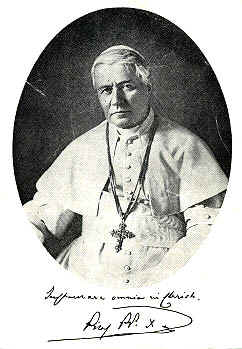
Venerable Brethren, Health and the Apostolic Blessing:
1. One of the primary obligations assigned by Christ to the office divinely committed to Us of feeding the Lord's flock is that of guarding with the greatest vigilance the deposit of the faith delivered to the saints, rejecting the profane novelties of words and the gainsaying of knowledge falsely so called. There has never been a time when this watchfulness of the supreme pastor was not necessary to the Catholic body, for owing to the efforts of the enemy of the human race, there have never been lacking "men speaking perverse things,"[1] "vain talkers and seducers,"[2] "erring and driving into error."[3] It must, however, be confessed that these latter days have witnessed a notable increase in the number of the enemies of the Cross of Christ, who, by arts entirely new and full of deceit, are striving to destroy the vital energy of the Church, and, as far as in them lies, utterly to subvert the very Kingdom of Christ. Wherefore We may no longer keep silence, lest We should seem to fail in Our most sacred duty, and lest the kindness that, in the hope of wiser counsels, We have hitherto shown them, should be set down to lack of diligence in the discharge of Our office.
2. That We should act without delay in this matter is made imperative especially by the fact that the partisans of error are to be sought not only among the Church's open enemies; but, what is to be most dreaded and deplored, in her very bosom, and are the more mischievous the less they keep in the open. We allude, Venerable Brethren, to many who belong to the Catholic laity, and, what is much more sad, to the ranks of the priesthood itself, who, animated by a false zeal for the Church, lacking the solid safeguards of philosophy and theology, nay more, thoroughly imbued with the poisonous doctrines taught by the enemies of the Church, and lost to all sense of modesty, put themselves forward as reformers of the Church; and, forming more boldly into line of attack, assail all that is most sacred in the work of Christ, not sparing even the Person of the Divine Redeemer, whom, with sacrilegious audacity, they degrade to the condition of a simple and ordinary mall.
3. Although they express their astonishment that We should number them amongst the enemies of the Church, no one will be reasonably surprised that We should do so, if, leaving out of account the internal disposition of the soul, of which Cod alone is the Judge, he considers their tenets, their manner of speech, and their action. Nor indeed would he be wrong in regarding them as the most pernicious of all the adversaries of the Church. For, as We have said, they put into operation their designs for her undoing, not from without but from within. Hence, the danger is present almost in the very veins and heart of the Church, whose injury is the more certain from the very fact that their knowledge of her is more intimate. Moreover, they lay the ax not to the branches and shoots, but to the very root, that is, to the faith and its deepest fibers. And once having struck at this root of immortality, they proceed to diffuse poison through the whole tree, so that there is no part of Catholic truth which they leave untouched, none that they do not strive to corrupt. Further, none is more skillful, none more astute than they, in the employment of a thousand noxious devices; for they play the double part of rationalist and Catholic, and this so craftily that they easily lead the unwary into error; and as audacity is their chief characteristic, there is no conclusion of any kind from which they shrink or which they do not thrust forward with pertinacity and assurance To this must be added the fact, which indeed is well calculated to deceive souls, that they lead a life of the greatest activity, of assiduous and ardent application to every branch of learning, and that they possess, as a rule, a reputation for irreproachable morality. Finally, there is the fact which is all hut fatal to the hope of cure that their very doctrines have given such a bent to their minds, that they disdain all authority and brook no restraint; and relying upon a false conscience, they attempt to ascribe to a love of truth that which is in reality the result of pride and obstinacy.
4. Once indeed We had hopes of recalling them to a better mind, and to this end We first of all treated them with kindness as Our children, then with severity; and at last We have had recourse, though with great reluctance, to public reproof. It is known to you, Venerable Brethren, how unavailing have been Our efforts. For a moment they have bowed their head, only to lift it more arrogantly than before. If it were a matter which concerned them alone, We might perhaps have overlooked it; but the security of the Catholic name is at stake. Wherefore We must interrupt a silence which it would be criminal to prolong, that We may point out to the whole Church, as they really are, men who are badly disguised.
5. It is one of the cleverest devices of the Modernists (as they are commonly and rightly called) to present their doctrines without order and systematic arrangement, in a scattered and disjointed manner, so as to make it appear as if their minds were in doubt or hesitation, whereas in reality they are quite fixed and steadfast. For this reason it will be of advantage, Venerable Brethren, to bring their teachings together here into one group, and to point out their interconnection, and thus to pass to an examination of the sources of the errors, and to prescribe remedies for averting the evil results.
6. To proceed in an orderly manner in this somewhat abstruse subject, it must first of all be noted that the Modernist sustains and includes within himself a manifold personality; he is a philosopher, a believer, a theologian, an historian, a critic, an apologist, a reformer. These roles must be clearly distinguished one from another by all who would accurately understand their system and thoroughly grasp the principles and the outcome of their doctrines.
7. We begin, then, with the philosopher. Modernists place the foundation of religious philosophy in that doctrine which is commonly called Agnosticism. According to this teaching human reason is confined entirely within the field of phenomena, that is to say, to things that appear, and in the manner in which they appear: it has neither the right nor the power to overstep these limits. Hence it is incapable of lifting itself up to God, and of recognizing His existence, even by means of visible things. From this it is inferred that God can never be the direct object of science, and that, as regards history, He must not be considered as an historical subject. Given these premises, everyone will at once perceive what becomes of Natural Theology, of the motives of credibility, of external revelation. The modernists simply sweep them entirely aside; they include them in Intellectualism, which they denounce as a system which is ridiculous and long since defunct. Nor does the fact that the Church has formally condemned these portentous errors exercise the slightest restraint upon them. Yet the Vatican Council has defined, "If anyone says that the one true God, our Creator and Lord, cannot be known with certainty by the natural light of human reason by means of the things that are made, let him be anathema";[4] and also, "If anyone says that it is not possible or not expedient that man be taught, through the medium of divine revelation, about God and the worship to be paid Him, let him be anathema";[5] and finally, "If anyone says that divine revelation cannot be made credible by external signs, and that therefore men should be drawn to the faith only by their personal internal experience or by private inspiration, let him be anathema."[6] It may be asked, in what way do the Modernists contrive to make the transition from Agnosticism, which is a state of pure nescience, to scientific and historic Atheism, which is a doctrine of positive denial; and consequently, by what legitimate process of reasoning, they proceed from the fact of ignorance as to whether God has in fact intervened in the history of the human race or not, to explain this history, leaving God out altogether, as if He really had not intervened. Let him answer who can. Yet it is a fixed and established principle among them that both science and history must be atheistic: and within their boundaries there is room for nothing but phenomena; God and all that is divine are utterly excluded. We shall soon see clearly what, as a consequence of this most absurd teaching, must be held touching the most sacred Person of Christ, and the mysteries of His life and death, and of His Resurrection and Ascension into Heaven.
8. However, this Agnosticism is only the negative part of the system of the Modernists: the positive part consists in what they call vital immanence. Thus they advance from one to the other. Religion, whether natural or supernatural, must, like every other fact, admit of some explanation. But when natural theology has been destroyed, and the road to revelation closed by the rejection of the arguments of credibility, and all external revelation absolutely denied, it is clear that this explanation will be sought in vain outside of man himself. It must, therefore, be looked for in man; and since religion is a form of life, the explanation must certainly be found in the life of man. In this way is formulated the principle of religious immanence. Moreover, the first actuation, so to speak, of every vital phenomenon--and religion, as noted above, belongs to this category--is due to a certain need or impulsion; but speaking more particularly of life, it has its origin in a movement of the heart, which movement is called a sense. Therefore, as God is the object of religion, we must conclude that faith, which is the basis and foundation of all religion, must consist in a certain interior sense, originating in a need of the divine. This need of the divine, which is experienced only in special and favorable circumstances. cannot of itself appertain to the domain of consciousness, but is first latent beneath consciousness, or, to borrow a term from modern philosophy, in the sub-consciousness, where also its root lies hidden and undetected. The "Need of the Divine" It may perhaps be asked how it is that this need of the divine which man experiences within himself resolves itself into religion? To this question the Modernist reply would be as follows: Science and history are confined within two boundaries, the one external, namely, the visible world, the other internal, which is consciousness. When one or other of these limits has been reached, there can be no further progress, for beyond is the unknowable. In presence of this unknowable, whether it is outside man and beyond the visible world of nature, or lies hidden within the sub-consciousness, the need of the divine in a soul which is prone to religion excites--according to the principles of Fideism, without any previous advertence of the mind--a certain special sense, and this sense possesses, implied within itself both as its own object and as its intrinsic cause, the divine reality itself, and in a way unites man with God. It is this sense to which Modernists give the name of faith, and this is what they hold to be the beginning of religion.
9. But we have not yet reached the end of their philosophizing, or, to speak more accurately, of their folly. Modernists find in this sense not only faith, but in and with faith, as they understand it, they affirm that there is also to be found revelation. For, indeed, what more is needed to constitute a revelation? Is not that religious sense which is perceptible in the conscience, revelation, or at least the beginning of revelation? Nay, is it not God Himself manifesting Himself, indistinctly, it is true, in this same religious sense, to the soul? And they add: Since God is both the object and the cause of faith, this revelation is at the same time of God and from God, that is to say, God is both the Revealer and the Revealed. Religious Consciousness and "Faith" From this, Venerable Brethren, springs that most absurd tenet of the Modernists, that every religion, according to the different aspect under which it is viewed, must be considered as both natural and supernatural. It is thus that they make consciousness and revelation synonymous. From this they derive the law laid down as the universal standard, according to which religious consciousness is to be put on an equal footing with revelation, and that to it all must submit, even the supreme authority of the Church, whether in the capacity of teacher, or in that of legislator in the province of sacred liturgy or discipline.
10. In all this process, from which, according to the Modernists, faith and revelation spring, one point is to be particularly noted, for it is of capital importance on account of the historico-critical corollaries which they deduce from it. The unknowable they speak of does not present itself to faith as something solitary and isolated; hut on the contrary in close conjunction with some phenomenon, which, though it belongs to the realms of science or history, yet to some extent exceeds their limits. Such a phenomenon may be a fact of nature containing within itself something mysterious; or it may be a man, whose character, actions, and words cannot, apparently, be reconciled with the ordinary laws of history. Then faith, attracted by the unknowable which is united with the phenomenon, seizes upon the whole phenomenon, and, as it were, permeates it with its own life. From this two things follow. The first is a sort of transfiguration of the phenomenon, by its elevation above its own true conditions, an elevation by which it becomes more adapted to clothe itself with the form of the divine character which faith will bestow upon it. The second consequence is a certain disfiguration--so it may be called--of the same phenomenon, arising from the fact that faith attributes to it, when stripped of the circumstances of place and time, characteristics which it does not really possess; and this takes place especially in the case of the phenomena of the past, and the more fully in the measure of their antiquity. From these two principles the Modernists deduce two laws, which, when united with a third which they have already derived from agnosticism, constitute the foundation of historic criticism. An example may be sought in the Person of Christ. In the Person of Christ, they say, science and history encounter nothing that is not human. Therefore, in virtue of the first canon deduced from agnosticism, whatever there is in His history suggestive of the divine must be rejected. Then, according to the second canon, the historical Person of Christ was transfigured by faith; therefore everything that raises it above historical conditions must be removed. Lastly, the third canon, which lays down that the Person of Christ has been disfigured by faith, requires that everything should be excluded, deeds and words and all else, that is not in strict keeping with His character, condition, and education, and with the place and time in which He lived. A method of reasoning which is passing strange, but in it we have the Modernist criticism.
11. It is thus that the religious sense, which through the agency of vital immanence emerges from the lurking-places of the sub-consciousness, is the germ of all religion, and the explanation of everything that has been or ever will be in any religion. This sense, which was at first only rudimentary and almost formless, under the influence of that mysterious principle from which it originated, gradually matured with the progress of human life, of which, as has been said, it is a certain form. This, then, is the origin of all. even of supernatural religion. For religions are mere developments of this religious sense. Nor is the Catholic religion an exception; it is quite on a level with the rest; for it was engendered, by the process of vital immanence, and by no other way, in the consciousness of Christ, who was a man of the choicest nature, whose like has never been, nor will be. In hearing these things we shudder indeed at so great an audacity of assertion and so great a sacrilege. And yet, Venerable Brethren, these are not merely the foolish babblings of unbelievers. There are Catholics, yea, and priests too, who say these things openly; and they boast that they are going to reform the Church by these ravings! The question is no longer one of the old error which claimed for human nature a sort of right to the supernatural. It has gone far beyond that, and has reached the point when it is affirmed that our most holy religion, in the man Christ as in us, emanated from nature spontaneously and of itself. Nothing assuredly could be more utterly destructive of the whole supernatural order. For this reason the Vatican Council most justly decreed: "If anyone says that man cannot be raised by God to a knowledge and perfection which surpasses nature, but that he can and should, by his own efforts and by a constant development, attain finally to the possession of all truth and good, let him be anathema."[7]
12. So far, Venerable Brethren, there has been no mention of the intellect. It also, according to the teaching of the Modernists, has its part in the act of faith. And it is of importance to see how. In that sense of which We have frequently spoken, since sense is not knowledge, they say God, indeed, presents Himself to man, but in a manner so confused and indistinct that He can hardly be perceived by the believer. It is therefore necessary that a certain light should be cast upon this sense so that God may clearly stand out in relief and be set apart from it. This is the task of the intellect, whose office it is to reflect and to analyze; and by means of it, man first transforms into mental pictures the vital phenomena which arise within him, and then expresses them in words. Hence the common saying of Modernists: that the religious man must think his faith. The mind then, encountering this .sense, throws itself upon it, and works in it after the manner of a painter who restores to greater clearness the lines of a picture that have been dimmed with age. The simile is that of one of the leaders of Modernism. The operation of the mind in this work is a double one: first, by a natural and spontaneous act it expresses its concept in a simple, popular statement; then, on reflection and deeper consideration, or, as they say, by elaborating its thought, it expresses the idea in secondary propositions, which are derived from the first, but are more precise and distinct. These secondary propositions, if they finally receive the approval of the supreme Magisterium of the Church, constitute dogma.
13. We have thus reached one of the principal points in the Modernists' system, namely, the origin and the nature of dogma. For they place the origin of dogma in those primitive and simple formulas, which, under a certain aspect, are necessary to faith; for revelation, to be truly such, requires the clear knowledge of God in the consciousness. But dogma itself, they apparently hold, strictly consists in the secondary formulas . The Nature of their "Dogma" To ascertain the nature of dogma, we must first find the relation which exists between the religious formulas and the religious sense. This will be readily perceived by anyone who holds that these formulas have no other purpose than to furnish the believer with a means of giving to himself an account of his faith. These formulas therefore stand midway between the believer and his faith; in their relation to the faith they are the inadequate expression of its object, and are usually called symbols; in their relation to the believer they are mere instruments. Dogmas are mere "Symbols" to the Modernist Hence it is quite impossible to maintain that they absolutely contain the truth: for, in so far as they are symbols, they are the images of truth, and so must be adapted to the religious sense in its relation to man; and as instruments, they are the vehicles of truth, and must therefore in their turn be adapted to man in his relation to the religious sense. But the object of the religious sense, as something contained in the absolute, possesses an infinite variety of aspects, of which now one, now another, may present itself. In like manner he who believes can avail himself of varying conditions. Consequently, the formulas which we call dogma must be subject to these vicissitudes, and are, therefore, liable to change. Thus the way is open to the intrinsic evolution of dogma. Here we have an immense structure of sophisms which ruin and wreck all religion.
14. Dogma is not only able, but ought to evolve and to be changed. This is strongly affirmed by the Modernists, and clearly flows from their principles. For among the chief points of their teaching is the following, which they deduce from the principle of vital immanence, namely, that religious formulas if they are to be really religious and not merely intellectual speculations, ought to be living and to live the life of the religious sense. This is not to be understood to mean that these formulas, especially if merely imaginative, were to be invented for the religious sense. Their origin matters nothing, any more than their number or quality. What is necessary is that the religious sense--with some modification when needful--should vitally assimilate them. In other words, it is necessary that the primitive formula be accepted and sanctioned by the heart; and similarly the subsequent work from which are brought forth the .secondary formulas must proceed under the guidance of the heart. Hence it comes that these formulas, in order to be living, should be, and should remain, adapted to the faith and to him who believes. Wherefore, if for any reason this adaptation should cease to exist, they lose their first meaning and accordingly need to be changed. In view of the fact that the character and lot of dogmatic formulas are so unstable, it is no wonder that Modernists should regard them so lightly and in such open disrespect, and have no consideration or praise for anything but the religious sense and for the religious life. In this way, with consummate audacity, they criticize the Church, as having strayed from the true path by failing to distinguish between the religious and moral sense of formulas and their surface meaning, and by clinging vainly and tenaciously to meaningless formulas, while religion itself is allowed to go to ruin. "Blind'- they are, and "leaders of the blind" puffed up with the proud name of science, they have reached that pitch of folly at which they pervert the eternal concept of truth and the true meaning of religion; in introducing a new system in which "they are seen to be under the sway of a blind and unchecked passion for novelty, thinking not at all of finding some solid foundation of truth, but despising the holy and apostolic traditions, they embrace other and vain, futile, uncertain doctrines, unapproved by the Church, on which, in the height of their vanity, they think they can base and maintain truth itself."[8]
15. Thus far, Venerable Brethren, We have considered the Modernist as a philosopher. Now if We proceed to consider him as a believer, and seek to know how the believer, according to Modernism, is marked off from the philosopher, it must be observed that, although the philosopher recognizes the reality of the divine as the object of faith, still this reality is not to be found by him but in the heart of the believer, as an object of feeling and affirmation, and therefore confined within the sphere of phenomena; but the question as to whether in itself it exists outside that feeling and affirmation is one which the philosopher passes over and neglects. For the Modernist believer, on the contrary, it is an established and certain fact that the reality of the divine does really exist in itself and quite independently of the person who believes in it. If you ask on what foundation this assertion of the believer rests, he answers: In the personal experience of the individual. On this head the Modernists differ from the Rationalists only to fall into the views of the Protestants and pseudo-mystics. The following is their manner of stating the question: In the religious sense one must recognize a kind of intuition of the heart which puts man in immediate contact with the reality of God, and infuses such a persuasion of God's existence and His action both within and without man as far to exceed any scientific conviction. They assert, therefore, the existence of a real experience, and one of a kind that surpasses all rational experience. If this experience is denied by some, like the Rationalists, they say that this arises from the fact that such persons are unwilling to put themselves in the moral state necessary to produce it. It is this experience which makes the person who acquires it to be properly and truly a believer. Destruction of the One, True Religion How far this position is removed from that of Catholic teaching! We have already seen how its fallacies have been condemned by the Vatican Council. Later on, we shall see how these errors, combined with those which we have already mentioned, open wide the way to Atheism. Here it is well to note at once that, given this doctrine of experience united with that of symbolism, every religion, even that of paganism, must be held to be true. What is to prevent such experiences from being found in any religion? In fact, that they are so is maintained by not a few. On what grounds can Modernists deny the truth of an experience affirmed by a follower of Islam? Will they claim a monopoly of true experiences for Catholics alone? Indeed, Modernists do not deny, but actually maintain, some confusedly, others frankly, that all religions are true. That they cannot feel otherwise is obvious. For on what ground, according to their theories, could falsity be predicated of any religion whatsoever? Certainly it would be either on account of the falsity of the religious .sense or on account of the falsity of the formula pronounced by the mind. Now the religious sense, although it maybe more perfect or less perfect, is always one and the same; and the intellectual formula, in order to be true, has but to respond to the religious sense and to the believer, whatever be the intellectual capacity of the latter. In the conflict between different religions, the most that Modernists can maintain is that the Catholic has more truth because it is more vivid, and that it deserves with more reason the name of Christian because it corresponds more fully with the origins of Christianity. No one will find it unreasonable that these consequences flow from the premises. But what is most amazing is that there are Catholics and priests, who, We would fain believe, abhor such enormities, and yet act as if they fully approved of them. For they lavish such praise and bestow such public honor on the teachers of these errors as to convey the belief that their admiration is not meant merely for the persons, who are perhaps not devoid of a certain merit, but rather for the sake of the errors which these persons openly profess and which they do all in their power to propagate.
16. There is yet another element in this part of their teaching which is absolutely contrary to Catholic truth. For what is laid down as to experience is also applied with destructive effect to tradition, which has always been maintained by the Catholic Church. Tradition, as understood by the Modernists, is a communication with others of an original experience, through preaching by means of the intellectual formula. To this formula, in addition to its representative value they attribute a species of suggestive efficacy which acts firstly in the believer by stimulating the religious sense, should it happen to have grown sluggish, and by renewing the experience once acquired, and secondly, in those who do not yet believe by awakening in them for the first time the religious sense and producing the experience. In this way is religious experience spread abroad among the nations; and not merely among contemporaries by preaching, but among future generations both by books and by oral transmission from one to another. Sometimes this communication of religious experience takes root and thrives, at other times it withers at once and dies. For the Modernists, to live is a proof of truth, since for them life and truth are one and the same thing. Thus we are once more led to infer that all existing religions are equally true, for otherwise they would not survive.
17. We have proceeded sufficiently far, Venerable Brethren, to have before us enough, and more than enough, to enable us to see what are the relations which Modernists establish between faith and science--including, as they are wont to do under that name, history. And in the first place it is to be held that the object-matter of the one is quite extraneous to and separate from the object-matter of the other. For faith occupies itself solely with something which science declares to be for it unknowable. Hence each has a separate scope assigned to it: science is entirely concerned with phenomena, into which faith does not at all enter; faith, on the contrary, concerns itself with the divine, which is entirely unknown to science. Thus it is contended that there can never be any dissension between faith and science, for if each keeps on its own ground they can never meet and therefore never can be in contradiction. And if it be objected that in the visible world there are some things which appertain to faith, such as the human life of Christ, the Modernists reply by denying this. For though such things come within the category of phenomena, still in as far as they are lived by faith and in the way already described have been by faith transfigured and disfigured, they have been removed from the world of sense and transferred into material for the divine. Hence should it be further asked whether Christ has wrought real miracles, and made real prophecies, whether He rose truly from the dead and ascended into Heaven, the answer of agnostic science will be in the negative and the answer of faith in the affirmative yet there will not be, on that account, any conflict between them. For it will be denied by the philosopher as a philosopher speaking to philosophers and considering Christ only in historical reality; and it will be affirmed by the believer as a believer speaking to believers and considering the life of Christ as lived again by the faith and in the faith.
18. It would be a great mistake, nevertheless, to suppose that, according to these theories, one is allowed to believe that faith and science are entirely independent of each other. On the side of science that is indeed quite true and correct, but it is quite otherwise with regard to faith, which is subject to science, not on one but on three grounds. For in the first place it must be observed that in every religious fact, when one takes away the divine reality and the experience of it which the believer possesses, everything else, and especially the religious formulas, belongs to the sphere of phenomena and therefore falls under the control of science. Let the believer go out of the world if he will, but so long as he remains in it, whether he like it or not, he cannot escape from the laws, the observation, the judgments of science and of history. Further, although it is contended that God is the object of faith alone, the statement refers only to the divine reality, not to the idea of God. The latter also is subject to science which, while it philosophizes in what is called the logical order, soars also to the absolute and the ideal. It is therefore the right of philosophy and of science to form its knowledge concerning the idea of God, to direct it in its evolution and to purify it of any extraneous elements which may have entered into it. Hence we have the Modernist axiom that the religious evolution ought to be brought into accord with the moral and intellectual, or as one whom they regard as their leader has expressed it, ought to be subject to it. Finally, man does not suffer a dualism to exist in himself, and the believer therefore feels within him an impelling need so to harmonize faith with science that it may never oppose the general conception which science sets forth concerning the universe. Thus it is evident that science is to be entirely independent of faith, while on the other hand, and notwithstanding that they are supposed to be strangers to each other, faith is made subject to science. All this, Venerable Brethren, is in formal opposition to the teachings of Our predecessor, Pius IX, where he lays it down that: "In matters of religion it is the duty of philosophy not to command but to serve, not to prescribe what is to be believed, but to embrace what is to be believed with reasonable obedience, not to scrutinize the depths of the mysteries of God, but to venerate them devoutly and humbly."[9] The Modernists completely invert the parts, and of them may be applied the words which another of Our predecessors Gregory IX, addressed to some theologians of his time: "Some among you, puffed up like bladders with the spirit of vanity strive by profane novelties to cross the boundaries fixed by the Fathers, twisting the meaning of the sacred text...to the philosophical teaching of the rationalists, not for the profit of their hearer but to make a show of science...these men, led away by various and strange doctrines, turn the head into the tail and force the queen to serve the handmaid."[10]
19. This will appear more clearly to anybody who studies the conduct of Modernists, which is in perfect harmony with their teachings. In their writings and addresses they seem not infrequently to advocate doctrines which are contrary one to the other, so that one would be disposed to regard their attitude as double and doubtful. But this is done deliberately and advisedly, and the reason of it is to be found in their opinion as to the mutual separation of science and faith. Thus in their books one finds some things which might well be approved by a Catholic, but on turning over the page one is confronted by other things which might well have been dictated by a rationalist. When they write history they make no mention of the divinity of Christ, but when they are in the pulpit they profess it clearly; again, when they are dealing with history they take no account of the Fathers and the Councils, but when they catechize the people, they cite them respectfully. In the same way they draw their distinctions between exegesis which is theological and pastoral and exegesis which is scientific and historical. So, too, when they treat of philosophy, history, and criticism, acting on the principle that science in no way depends upon faith, they feel no especial horror in treading in the footsteps of Luther[11] and are wont to display a manifold contempt for Catholic doctrines, for the Holy Fathers, for the Ecumenical Councils, for the ecclesiastical Magisterium; and should they be taken to task for this, they complain that they are being deprived of their liberty. Lastly, maintaining the theory that faith must be subject to science, they continuously and openly rebuke the Church on the ground that she resolutely refuses to submit and accommodate her dogmas to the opinions of philosophy; while they, on their side, having for this purpose blotted out the old theology, endeavor to introduce a new theology which shall support the aberrations of philosophers.
20. At this point, Venerable Brethren, the way is opened for us to consider the Modernists in the theological arena--a difficult task, yet one that may be disposed of briefly. It is a question of effecting the conciliation of faith with science, but always by making the one subject to the other. In this matter the Modernist theologian takes exactly the same principles which we have seen employed by the Modernist philosopher--the principles of immanence and symbolism--and applies them to the believer. The process is an extremely simple one. The philosopher has declared: The principle of faith is immanent; the believer has added: This principle is God; and the theologian draws the conclusion: God is immanent in man. Thus we have theological immanence. So, too, the philosopher regards it as certain that the representations of the object of faith are merely symbolical; the believer has likewise affirmed that the object of faith is God in himself; and the theologian proceeds to affirm that: The representations of the divine reality are symbolical. And thus we have theological symbolism. These errors are truly of the gravest kind and the pernicious character of both will be seen clearly from an examination of their consequences. For, to begin with symbolism, since symbols are but symbols in regard to their objects and only instruments in regard to the believer, it is necessary first of all, according to the teachings of the Modernists, that the believer does not lay too much stress on the formula, as formula, but avail himself of it only for the purpose of uniting himself to the absolute truth which the formula at once reveals and conceals, that is to say, endeavors to express but without ever succeeding in doing so. They would also have the believer make use of the formulas only in as far as they are helpful to him, for they are given to be a help and not a hindrance; with proper regard, however, for the social respect due to formulas which the public magisterium has deemed suitable for expressing the common consciousness until such time as the same magisterium shall provide otherwise. Concerning immanence it is not easy to determine what Modernists precisely mean by it, for their own opinions on the subject vary. Some understand it in the sense that God working in man is more intimately present in him than man is even in himself; and this conception, if properly understood, is irreproachable. Others hold that the divine action is one with the action of nature, as the action of the first cause is one with the action of the secondary cause; and this would destroy the supernatural order. Others, finally, explain it in a way which savors of pantheism, and this, in truth, is the sense which best fits in with the rest of their doctrines.
21. With this principle of immanence is connected another which may be called the principle of divine permanence. It differs from the first in much the same way as the private experience differs from the experience transmitted by tradition. An example illustrating what is meant will be found in the Church and the sacraments. The Church and the sacraments according to the Modernists, are not to be regarded as having been instituted by Christ Himself. This is barred by agnosticism, which recognizes in Christ nothing more than a man whose religious consciousness has been, like that of all men, formed by degrees; it is also barred by the law of immanence, which rejects what they call external application; it is further barred by the law of evolution, which requires, for the development of the germs, time and a certain series of circumstances; it is finally, barred by history, which shows that such in fact has been the course of things. Still it is to he held that both Church and sacraments have been founded mediately by Christ. But how? In this way: All Christian consciences were, they affirm, in a manner virtually included in the conscience of Christ as the plant is included in the seed. But as the branches live the life of the seed, so, too, all Christians are to be said to live the life of Christ. But the life of Christ, according to faith, is divine, and so, too, is the life of Christians. And if this life produced, in the course of ages, both the Church and the sacraments, it is quite right to say that their origin is from Christ and is divine. In the same way they make out that the Holy Scriptures and the dogmas are divine. And in this, the Modernist theology may be said to reach its completion. A slender provision, in truth, but more than enough for the theologian who professes that the conclusions of science, whatever they may be, must always be accepted! No one will have any difficulty in making the application of these theories to the other points with which We propose to deal.
22. Thus far We have touched upon the origin and nature of faith. But as faith has many branches, and chief among them the Church, dogma, worship, devotions, the Books which we call "sacred," it concerns us to know what the Modernists teach concerning them. To begin with dogma, We have already indicated its origin and nature. Dogma is born of a sort of impulse or necessity by virtue of which the believer elaborates his thought so as to render it clearer to his own conscience and that of others. This elaboration consists entirely in the process of investigating and refining the primitive mental formula, not indeed in itself and according to any logical explanation, but according to circumstances, or vitally as the Modernists somewhat less intelligibly describe it. Hence it happens that around this primitive formula secondary formulas, as We have already indicated, gradually continue to be formed, and these subsequently grouped into one body, or one doctrinal construction and further sanctioned by the public magisterium as responding to the common consciousness, are called dogma. Dogma is to be carefully distinguished from the speculations of theologians which, although not alive with the life of dogma, are not without their utility as serving both to harmonize religion with science and to remove opposition between them, and to illumine and defend religion from without, and it may be even to prepare the matter for future dogma. Concerning worship there would not be much to be said, were it not that under this head are comprised the sacraments, concerning which the Modernist errors are of the most serious character. For them the sacraments are the resultant of a double impulse or need--for, as we have seen, everything in their system is explained by inner impulses or necessities. The first need is that of giving some sensible manifestation to religion; the second is that of expressing it, which could not be done without some sensible form and consecrating acts, and these are called sacraments. But for the Modernists, sacraments are bare symbols or signs, though not devoid of a certain efficacy--an efficacy, they tell us, like that of certain phrases vulgarly described as having caught the popular ear, inasmuch as they have the power of putting certain leading ideas into circulation, and of making a marked impression upon the mind. What the phrases are to the ideas, that the sacraments are to the religious sense, that and nothing more. The Modernists would express their mind more clearly were they to affirm that the sacraments are instituted solely to foster the faith but this is condemned by the Council of Trent: If anyone says that these sacraments are instituted solely to foster the faith, let him be anathema.[12]
23. We have already touched upon the nature and origin of the Sacred Books. According to the principles of the Modernists they may be rightly described as a summary of experiences, not indeed of the kind that may now and again come to anybody, but those extraordinary and striking experiences which are the possession of every religion. And this is precisely what they teach about our books of the Old and New Testament. But to suit their own theories they note with remarkable ingenuity that, although experience is something belonging to the present, still it may draw its material in like manner from the past and the future inasmuch as the believer by memory lives the past over again after the manner of the present, and lives the future already by anticipation. This explains how it is that the historical and apocalyptic books are included among the Sacred Writings. God does indeed speak in these books through the medium of the believer, but according to Modernist theology, only by immanence and vital permanence. We may ask, what then becomes of inspiration? Inspiration, they reply, is in nowise distinguished from that impulse which stimulates the believer to reveal the faith that is in him by words of writing, except perhaps by its vehemence. It is something like that which happens in poetical inspiration, of which it has been said: There is a God in us, and when he stirreth he sets us afire. It is in this sense that God is said to be the origin of the inspiration of the Sacred Books. The Modernists moreover affirm concerning this inspiration, that there is nothing in the Sacred Books which is devoid of it. In this respect some might be disposed to consider them as more orthodox than certain writers in recent times who somewhat restrict inspiration, as, for instance, in what have been put forward as so-called tacit citations. But in all this we have mere verbal conjuring. For if we take the Bible, according to the standards of agnosticism, namely, as a human work, made by men for men, albeit the theologian is allowed to proclaim that it is divine by immanence, what room is there left in it for inspiration? The Modernists assert a general inspiration of the Sacred Books, but they admit no inspiration in the Catholic sense.
24. A wider field for comment is opened when we come to what the Modernist school has imagined to be the nature of the Church. They begin with the supposition that the Church has its birth in a double need; first, the need of the individual believer to communicate his faith to others, especially if he has had some original and special experience, and secondly, when the faith has become common to many, the need of the collectivity to form itself into a society and to guard, promote, and propagate the common good. What, then, is the Church? It is the product of the collective conscience, that is to say, of the association of individual consciences which, by virtue of the principle of vital permanence, depend all on one first believer, who for Catholics is Christ. Now every society needs a directing authority to guide its members towards the common end, to foster prudently the elements of cohesion, which in a religious society are doctrine and worship. Hence the triple authority in the Catholic Church, disciplinary, dogmatic, liturgical. The nature of this authority is to be gathered from its origin, and its rights and duties from its nature. In past times it was a common error that authority came to the Church from without, that is to say directly from God; and it was then rightly held to be autocratic. But this conception has now grown obsolete. For in the same way as the Church is a vital emanation of the collectivity of consciences, so too authority emanates vitally from the Church itself. Authority, therefore, like the Church, has its origin in the religious conscience, and, that being so, is subject to it. Should it disown this dependence it becomes a tyranny. For we are living in an age when the sense of liberty has reached its highest development. In the civil order the public conscience has introduced popular government. Now there is in man only one conscience, just as there is only one life. It is for the ecclesiastical authority, therefore, to adopt a democratic form, unless it wishes to provoke and foment an intestine conflict in the consciences of mankind. The penalty of refusal is disaster. For it is madness to think that the sentiment of liberty, as it now obtains, can recede. Were it forcibly pent up and held in bonds, the more terrible would be its outburst, sweeping away at once both Church and religion. Such is the situation in the minds of the Modernists, and their one great anxiety is, in consequence, to find a way of conciliation between the authority of the Church and the liberty of the believers.
25. But it is not only within her own household that the Church must come to terms. Besides her relations with those within, she has others with those who are outside. The Church does not occupy the world all by herself; there are other societies in the world., with which she must necessarily have dealings and contact. The rights and duties of the Church towards civil societies must, therefore, be determined, and determined, of course, by her own nature, that, to wit, which the Modernists have already described to us. The rules to be applied in this matter are clearly those which have been laid down for science and faith, though in the latter case the question turned upon the object, while in the present case we have one of ends. In the same way, then, as faith and science are alien to each other by reason of the diversity of their objects, Church and State are strangers by reason of the diversity of their ends, that of the Church being spiritual while that of the State is temporal. Formerly it was possible to subordinate the temporal to the spiritual and to speak of some questions as mixed, conceding to the Church the position of queen and mistress in all such, because the Church was then regarded as having been instituted immediately by God as the author of the supernatural order. But this doctrine is today repudiated alike by philosophers and historians. The state must, therefore, be separated from the Church, and the Catholic from the citizen. Every Catholic, from the fact that he is also a citizen, has the right and the duty to work for the common good in the way he thinks best, without troubling himself about the authority of the Church, without paying any heed to its wishes, its counsels, its orders--nay, even in spite of its rebukes. For the Church to trace out and prescribe for the citizen any line of action, on any pretext whatsoever, is to be guilty of an abuse of authority, against which one is bound to protest with all one's might. Venerable Brethren, the principles from which these doctrines spring have been solemnly condemned by Our predecessor, Pius VI, in his Apostolic Constitution Auctorem Fidei.[13]
26. But it is not enough for the Modernist school that the State should be separated from the Church. For as faith is to be subordinated to science as far as phenomenal elements are concerned, so too in temporal matters the Church must be subject to the State. This, indeed, Modernists may not yet say openly, but they are forced by the logic of their position to admit it. For granted the principle that in temporal matters the State possesses the sole power, it will follow that when the believer, not satisfied with merely internal acts of religion, proceeds to external acts--such for instance as the reception or administration of the sacraments--these will fall under the control of the State. What will then become of ecclesiastical authority, which can only be exercised by external acts? Obviously it will be completely under the dominion of the State. It is this inevitable consequence which urges many among liberal Protestants to reject all external worship--nay, all external religious fellowship, and leads them to advocate what they call individual religion. If the Modernists have not yet openly proceeded so far, they ask the Church in the meanwhile to follow of her own accord in the direction in which they urge her and to adapt herself to the forms of the State. Such are their ideas about disciplinary authority. But much more evil and pernicious are their opinions on doctrinal and dogmatic authority. The following is their conception of the Magisterium of the Church: No religious society, they say, can be a real unit unless the religious conscience of its members be one, and also the formula which they adopt. But this double unity requires a kind of common mind whose office is to find and determine the formula that corresponds best with the common conscience; and it must have, moreover, an authority sufficient to enable it to impose on the community the formula which has been decided upon. From the combination and, as it were, fusion of these two elements, the common mind which draws up the formula and the authority which imposes it, arises, according to the Modernists, the notion of the ecclesiastical Magisterium. And, as this Magisterium springs, in its last analysis, from the individual consciences and possesses its mandate of public utility for their benefit, it necessarily follows that the ecclesiastical Magisterium must be dependent upon them, and should therefore be made to bow to the popular ideals. To prevent individual consciences from expressing freely and openly the impulses they feel, to hinder criticism from urging forward dogma in the path of its necessary evolution, is not a legitimate use but an abuse of a power given for the public weal. So too a due method and measure must be observed in the exercise of authority. To condemn and proscribe a work without the knowledge of the author, without hearing his explanations, without discussion, is something approaching to tyranny. And here again it is a question of finding a way of reconciling the full rights of authority on the one hand and those of liberty on the other. In the meantime the proper course for the Catholic will be to proclaim publicly his profound respect for authority, while never ceasing to follow his own judgment. Their general direction for the Church is as follows: that the ecclesiastical authority, since its end is entirely spiritual, should strip itself of that external pomp which adorns it in the eyes of the public. In this, they forget that while religion is for the soul, it is not exclusively for the soul, and that the honor paid to authority is reflected back on Christ who instituted it.
27. To conclude this whole question of faith and its various branches, we have still to consider, Venerable Brethren, what the Modernists have to say about the development of the one and the other. First of all they lay down the general principle that in a living religion everything is subject to change, and must in fact be changed. In this way they pass to what is practically their principal doctrine, namely, evolution. To the laws of evolution everything is subject under penalty of death--dogma, Church, worship, the Books we revere as sacred, even faith itself. The enunciation of this principle will not be a matter of surprise to anyone who bears in mind what the Modernists have had to say about each of these subjects. Having laid down this law of evolution, the Modernists themselves teach us how it operates. And first, with regard to faith. The primitive form of faith, they tell us, was rudimentary and common to all men alike, for it had its origin in human nature and human life. Vital evolution brought with it progress, not by the accretion of new and purely adventitious forms from without, but by an increasing perfusion of the religious sense into the conscience. The progress was of two kinds: negative, by the elimination of all extraneous elements, such, for example, as those derived from the family or nationality; and positive, by that intellectual and moral refining of man, by means of which the idea of the divine became fuller and clearer, while the religious sense became more acute. For the progress of faith the same causes are to be assigned as those which are adduced above to explain its origin. But to them must be added those extraordinary men whom we call prophets--of whom Christ was the greatest--both because in their lives and their words there was something mysterious which faith attributed to the divinity, and because it fell to their lot to have new and original experiences fully in harmony with the religious needs of their time. The progress of dogma is due chiefly to the fact that obstacles to the faith have to be surmounted, enemies have to be vanquished, and objections have to be refuted. Add to this a perpetual striving to penetrate ever more profoundly into those things which are contained in the mysteries of faith. Thus, putting aside other examples, it is found to have happened in the case of Christ: in Him that divine something which faith recognized in Him was slowly and gradually expanded in such a way that He was at last held to be God. The chief stimulus of the evolution of worship consists in the need of accommodation to the manners and customs of peoples, as well as the need of availing itself of the value which certain acts have acquired by usage. Finally, evolution in the Church itself is fed by the need of adapting itself to historical conditions and of harmonizing itself with existing forms of society. Such is their view with regard to each. And here, before proceeding further, We wish to draw attention to this whole theory of necessities or needs, for beyond all that we have seen, it is, as it were, the base and foundation of that famous method which they describe as historical.
28. Although evolution is urged on by needs or necessities, yet, if controlled by these alone, it would easily overstep the boundaries of tradition, and thus, separated from its primitive vital principle, would make for ruin instead of progress. Hence, by those who study more closely the ideas of the Modernists, evolution is described as a resultant from the conflict of two forces, one of them tending towards progress, the other towards conservation. The conserving force exists in the Church and is found in tradition; tradition is represented by religious authority, and this both by right and in fact. By right, for it is in the very nature of authority to protect tradition: and in fact, since authority, raised as it is above the contingencies of life, feels hardly, or not at all, the spurs of progress. The progressive force, on the contrary, which responds to the inner needs, lies in the individual consciences and works in them--especially in such of them as are in more close and intimate contact with life. Already we observe, Venerable Brethren, the introduction of that most pernicious doctrine which would make of the laity the factor of progress in the Church. Now it is by a species of covenant and compromise between these two forces of conservation and progress, that is to say between authority and individual consciences, that changes and advances take place. The individual consciences, or some of them, act on the collective conscience, which brings pressure to bear on the depositories of authority to make terms and to keep to them. The Modernist Complex With all this in mind, one understands how it is that the Modernists express astonishment when they are reprimanded or punished. What is imputed to them as a fault they regard as a sacred duty. They understand the needs of consciences better than anyone else, since they come into closer touch with them than does the ecclesiastical authority. Nay, they embody them, so to speak, in themselves. Hence, for them to speak and to write publicly is a bounden duty. Let authority rebuke them if it pleases--they have their own conscience on their side and an intimate experience which tells them with certainty that what they deserve is not blame but praise. Then they reflect that, after all, there is no progress without a battle and no battle without its victims; and victims they are willing to be like the prophets and Christ Himself. They have no bitterness in their hearts against the authority which uses them roughly, for after all they readily admit that it is only doing its duty as authority. Their sole grief is that it remains deaf to their warnings, for in this way it impedes the progress of souls, but the hour will most surely come when further delay will be impossible, for if the laws of evolution may be checked for a while they cannot be finally evaded. And thus they go their way, reprimands and condemnations not withstanding, masking an incredible audacity under a mock semblance of humility. While they make a pretense of bowing their heads, their minds and hands are more boldly intent than ever on carrying out their purposes. And this policy they follow willingly and wittingly, both because it is part of their system that authority is to be stimulated but not dethroned, and because it is necessary for them to remain within the ranks of the Church in order that they may gradually transform the collective conscience. And in saying this, they fail to perceive that they are avowing that the collective conscience is not with them, and that they have no right to claim to be its interpreters.
29. It is thus, Venerable Brethren, that for the Modernists, whether as authors or propagandists, there is to be nothing stable, nothing immutable in the Church. Nor, indeed, are they without forerunners in their doctrines, for it was of these that Our predecessor Pius IX wrote: "These enemies of divine revelation extol human progress to the skies, and with rash and sacrilegious daring would have it introduced into the Catholic religion as if this religion were not the work of God but of man, or some kind of philosophical discovery susceptible of perfection by human efforts."[14] On the subject of revelation and dogma in particular, the doctrine of the Modernists offers nothing new. We find it condemned in the Syllabus of Pius IX, where it is enunciated in these terms: "Divine revelation is imperfect, and therefore subject to continual and indefinite progress, corresponding with the progress of human reason";[15] and condemned still more solemnly in the Vatican Council: "The doctrine of the faith which God has revealed has not been proposed to human intelligence to be perfected by them as if it were a philosophical system, but as a divine deposit entrusted to the Spouse of Christ to be faithfully guarded and infallibly interpreted. Hence also that sense of the sacred dogmas is to be perpetually retained which our Holy Mother the Church has once declared, nor is this sense ever to be abandoned on plea or pretext of a more profound comprehension of the truth."[16] Nor is the development of our knowledge, even concerning the faith, barred by this pronouncement; on the contrary, it is supported and maintained. For the same Council continues: "Let intelligence and science and wisdom, therefore, increase and progress abundantly and vigorously in individuals, and in the mass, in the believer and in the whole Church, throughout the ages and the centuries--but only in its own kind, that is, according to the same dogma, the same sense, the same acceptation."[17]
30. We have studied the Modernist as philosopher, believer, and theologian. It now remains for us to consider him as historian, critic, apologist, and reformer.
31. Some Modernists, devoted to historical studies, seem to be deeply anxious not to be taken for philosophers. About philosophy they profess to know nothing whatever, and in this they display remarkable astuteness, for they are particularly desirous not to be suspected of any prepossession in favor of philosophical theories which would lay them open to the charge of not being, as they call it, objective. And yet the truth is that their history and their criticism are saturated with their philosophy, and that their historico-critical conclusions are the natural outcome of their philosophical principles. This will be patent to anyone who reflects. Their three first laws are contained in those three principles of their philosophy already dealt with: the principle of agnosticism, the theorem of the transfiguration of things by faith, and that other which may be called the principle of disfiguration. Let us see what consequences flow from each of these. Agnosticism tells us that history, like science, deals entirely with phenomena, and the consequence is that God, and every intervention of God in human affairs, is to be relegated to the domain of faith as belonging to it alone. Wherefore in things where there is combined a double element, the divine and the human, as, for example, in Christ, or the Church, or the sacraments, or the many other objects of the same kind, a division and separation must be made and the human element must he left to history while the divine will he assigned to faith. Hence we have that distinction, so current among the Modernists, between the Christ of history and the Christ of faith; the Church of history and the Church of faith; the sacraments of history and the sacraments of faith, and so in similar matters. Next we find that the human element itself, which the historian has to work on, as it appears in the documents, is to be considered as having been transfigured by faith, that is to say, raised above its historical conditions. It becomes necessary, therefore, to eliminate also the accretions which faith has added, to relegate them to faith itself and to the history of faith. Thus, when treating of Christ, the historian must set aside all that surpasses man in his natural condition, according to what psychology tells us of him, or according to what we gather from the place and period of his existence. Finally, they require, by virtue of the third principle, that even those things which are not outside the sphere of history should pass through the sieve, excluding all and relegating to faith everything which, in their judgment, is not in harmony with what they call the logic of facts or not in character with the persons of whom they are predicated. Thus, they will not allow that Christ ever uttered those things which do not seem to be within the capacity of the multitudes that listened to Him. Hence they delete from His real history and transfer to faith all the allegories found in His discourses. We may peradventure inquire on what principle they make these divisions? Their reply is that they argue from the character of the man, from his condition of life, from his education, from the complexus of the circumstances under which the facts took place; in short, if We understand them aright, on a principle which in the last analysis is merely .subjective. Their method is to put themselves into the position and person of Christ, and then to attribute to Him what they would have done under like circumstances. In this way, absolutely a priori and acting on philosophical principles which they hold but which they profess to ignore, they proclaim that Christ, according to what they call His real history, was not God and never did anything divine, and that as man He did and said only what they, judging from the time in which He lived, consider that He ought to have said or done.
32. As history takes its conclusions from philosophy, so too criticism takes its conclusions from history. The critic on the data furnished him by the historian, makes two parts of all his documents. Those that remain after the triple elimination above described go to form the real history; the rest is attributed to the history of the faith or, as it is styled, to internal history. For the Modernists distinguish very carefully between these two kinds of history, and it is to be noted that they oppose the history of the faith to real history precisely as real. Thus, as we have already said, we have a twofold Christ: a real Christ, and a Christ, the one of faith, who never really existed; a Christ who has lived at a given time and in a given place, and a Christ who never lived outside the pious meditations of the believer--the Christ, for instance, whom we find in the Gospel of St. John, which, according to them, is mere meditation from beginning to end.
33. But the dominion of philosophy over history does not end here. Given that division, of which We have spoken, of the documents into two parts, the philosopher steps in again with his dogma of vital immanence, and shows how everything in the history of the Church is to be explained by vital emanation. And since the cause or condition of every vital emanation whatsoever is to be found in some need or want, it follows that no fact can be regarded as antecedent to the need which produced it--historically the fact must be posterior to the need. What, then, does the historian do in view of this principle? He goes over his documents again, whether they be contained in the Sacred Books or elsewhere, draws up from them his list of the particular needs of the Church, whether relating to dogma, or liturgy, or other matters which are found in the Church thus related, and then he hands his list over to the critic. The critic takes in hand the documents dealing with the history of faith and distributes them, period by period, so that they correspond exactly with the list of needs, always guided by the principle that the narration must follow the facts, as the facts follow the needs. It may at times happen that some parts of the Sacred Scriptures, such as the Epistles, themselves constitute the fact created by the need. Even so, the rule holds that the age of any document can only be determined by the age in which each need has manifested itself in the Church. Further, a distinction must be made between the beginning of a fact and its development, for what is born in one day requires time for growth. Hence the critic must once more go over his documents, ranged as they are through the different ages, and divide them again into two parts, separating those that regard the origin of the facts from those that deal with their development, and these he must again arrange according to their periods.
34. Then the philosopher must come in again to enjoin upon the historian the obligation of following in all his studies the precepts and laws of evolution. It is next for the historian to scrutinize his documents once more, to examine carefully the circumstances and conditions affecting the Church during the different periods, the conserving force she has put forth, the needs both internal and external that have stimulated her to progress, the obstacles she has had to encounter, in a word, everything that helps to determine the manner in which the laws of evolution have been fulfilled in her. This done, he finishes his work by drawing up a history of the development in its broad lines. The critic follows and fits in the rest of the documents. He sets himself to write. The history is finished. Now We ask here: Who is the author of this history? The historian? The critic? Assuredly neither of these but the philosopher. From beginning to end everything in it is a priori, and an apriorism that reeks of heresy. These men are certainly to be pitied, of whom the Apostle might well say: "They became vain in their thoughts...professing themselves to be wise, they became fools."[18] At the same time, they excite resentment when they accuse the Church of arranging and confusing the texts after her own fashion, and for the needs of her cause. In this they are accusing the Church of something for which their own conscience plainly reproaches them.
35. The result of this dismembering of the records, and this partition of them throughout the centuries is naturally that the Scriptures can no longer be attributed to the authors whose names they bear. The Modernists have no hesitation in affirming generally that these books, and especially the Pentateuch and the first three Gospels, have been gradually formed from a primitive brief narration, by additions, by interpolations of theological or allegorical interpretations, or parts introduced only for the purpose of joining different passages together. This means, to put it briefly and clearly, that in the Sacred Books we must admit a vital evolution, springing from and corresponding with the evolution of faith. The traces of this evolution, they tell us, are so visible in the books that one might almost write a history of it. Indeed, this history they actually do write, and with such an easy assurance that one might believe them to have seen with their own eyes the writers at work through the ages amplifying the Sacred Books. To aid them in this they call to their assistance that branch of criticism which they call textual, and labor to show that such a fact or such a phrase is not in its right place, adducing other arguments of the same kind. They seem, in fact, to have constructed for themselves certain types of narration and discourses, upon which they base their assured verdict as to whether a thing is or is not out of place. Let him who can judge how far they are qualified in this way to make such distinctions. To hear them descant of their works on the Sacred Books, in which they have been able to discover so much that is defective, one would imagine that before them nobody ever even turned over the pages of Scripture. The truth is that a whole multitude of Doctors, far superior to them in genius, in erudition, in sanctity, have sifted the Sacred Books in every way, and so far from finding in them anything blameworthy have thanked God more and more heartily the more deeply they have gone into them, for His divine bounty in having vouchsafed to speak thus to men. Unfortunately. these great Doctors did not enjoy the same aids to study that are possessed by the Modernists for they did not have for their rule and guide a philosophy borrowed from the negation of God, and a criterion which consists of themselves . Modernist Criticism is opposed to Catholic Teaching We believe, then, that We have set forth with sufficient clearness the historical method of the Modernists. The philosopher leads the way, the historian follows, and then in due order come the internal and textual critics. And since it is characteristic of the primary cause to communicate its virtue to causes which are secondary, it is quite clear that the criticism with which We are concerned is not any kind of criticism, but that which is rightly called agnostic, immanentist, and evolutionist criticism. Hence anyone who adopts it and employs it makes profession thereby of the errors contained in it, and places himself in opposition to Catholic teaching. This being so, it is much a matter for surprise that it should have found acceptance to such an extent among certain Catholics. Two causes may be assigned for this: first, the close alliance which the historians and critics of this school have formed among themselves independent of all differences of nationality or religion; second, their boundless effrontery by which, if one then makes any utterance, the others applaud him in chorus, proclaiming that science has made another step forward, while if an outsider should desire to inspect the new discovery for himself, they form a coalition against him. He who denies it is decried as one who is ignorant, while he who embraces and defends it has all their praise. In this way they entrap not a few, who, did they but realize what they are doing, would shrink back with horror. The domineering overbearance of those who teach the errors, and the thoughtless compliance of the more shallow minds who assent to them, create a corrupted atmosphere which penetrates everywhere, and carries infection with it. But let Us pass to the apologist.
36. The Modernist apologist depends in two ways on the philosopher. First, indirectly, inasmuch as his subject-matter is history--history dictated, as we have seen, by the philosopher; and, secondly, directly, inasmuch as he takes both his doctrines and his conclusions from the philosopher. Hence that common axiom of the Modernist school that in the new apologetics controversies in religion must be determined by psychological and historical research. The Modernist apologists, then, enter the arena, proclaiming to the rationalists that, though they are defending religion, they have no intention of employing the data of the sacred books or the histories in current use in the Church, and written upon the old lines, but real history composed on modern principles and according to the modern method. In all this they assert that they are not using an argumentum ad hominem, because they are really of the opinion that the truth is to be found only in this kind of history. They feel that it is not necessary for them to make profession of their own sincerity in their writings. They are already known to and praised by the rationalists as fighting under the same banner, and they not only plume themselves on these encomiums, which would only provoke disgust in a real Catholic, but use them as a counter-compensation to the reprimands of the Church. Modernist Apologetic Procedure Let us see how the Modernist conducts his apologetics. The aim he sets before himself is to make one who is still without faith attain that experience of the Catholic religion which, according to the system, is the sole basis of faith. There are two ways open to him, the objective and the subjective. The first of them starts from agnosticism. It tends to show that religion, and especially the Catholic religion, is endowed with such vitality as to compel every psychologist and historian of good faith to recognize that its history hides some element of the unknown. To this end it is necessary to prove that the Catholic religion, as it exists today, is that which was founded by Jesus Christ; that is to say, that it is nothing else than the progressive development of the germ which He brought into the world. Hence it is imperative first of all to establish what this germ was, and this the Modernist claims to he able to do by the following formula: Christ announced the coming of the kingdom of God, which was to be realized within a brief lapse of time and of which He was to become the Messias, the divinely-given founder and ruler. Then it must be shown how this germ, always immanent and permanent in the Catholic religion, has gone on slowly developing in the course of history, adapting itself successively to the different circumstances through which it has passed, borrowing from them by vital assimilation all the doctrinal, cultural, ecclesiastical forms that served its purpose; whilst, on the other hand, it surmounted all obstacles, vanquished all enemies, and survived all assaults and all combats. Anyone who well and duly considers this mass of obstacles, adversaries, attacks, combats, and the vitality and fecundity which the Church has shown throughout them all, must admit that if the laws of evolution are visible in her life they fail to explain the whole of her history--the unknown rises forth from it and presents itself before Us. Thus do they argue, not perceiving that their determination of the primitive germ is only an a priori assumption of agnostic and evolutionist philosophy, and that the germ itself has been gratuitously defined so that it may fit in with their contention.
37. But while they endeavor by this line of reasoning to prove and plead for the Catholic religion, these new apologists are more than willing to grant and to recognize that there are in it many things which are repulsive. Nay, they admit openly, and with ill-concealed satisfaction, that they have found that even its dogma is not exempt from errors and contradictions. They add also that this is not only excusable but--curiously enough--that it is even right and proper. In the Sacred Books there are many passages referring to science or history where, according to them, manifest errors are to he found. But, they say, the subject of these books is not science or history, but only religion and morals. In them history and science serve only as a species of covering to enable the religious and moral experiences wrapped Up in them to penetrate more readily among the masses. The masses understood science and history as they are expressed in these books, and it is clear that the expression of science and history in a more perfect form would have proved not so much a help as a hindrance. Moreover, they add, the Sacred Books, being essentially religious, are necessarily quick with life. Now life has its own truths and its own logic--quite different from rational truth and rational logic, belonging as they do to a different order, viz., truth of adaptation and of proportion both with what they call the medium in which it lives and with the end for which it lives. Finally, the Modernists, losing all sense of control, go so far as to proclaim as true and legitimate whatever is explained by life. The Simplicity of the Truth We, Venerable Brethren, for whom there is but one and only one truth, and who hold that the Sacred Books, "written under the inspiration of the Holy Ghost, have God for their author"[19] declare that this is equivalent to attributing to God Himself the lie of utility or officious lie, and We say with St. Augustine: "In an authority so high, admit but one officious lie, and there will not remain a single passage of those apparently difficult to practice or to believe, which on the same most pernicious rule may not be explained as a lie uttered by the author willfully and to serve a purpose."[20] And thus it will come about, the holy Doctor continues, that "everybody will believe and refuse to believe what he likes or dislikes in them," namely, the Scriptures. But the Modernists pursue their way eagerly. They grant also that certain arguments adduced in the Sacred Books in proof of a given doctrine, like those, for example, which are based on the prophecies, have no rational foundation to rest on. But they defend even these as artifices of preaching, which are justified by life. More than that. They are ready to admit, nay, to proclaim that Christ Himself manifestly erred in determining the time when the coming of the Kingdom of God was to take place; and they tell us that we must not be surprised at this since even He Himself was subject to the laws of life! After this what is to become of the dogmas of the Church? The dogmas bristle with flagrant contradictions, but what does it matter since, apart from the fact that vital logic accepts them, they are not repugnant to symbolical truth. Are we not dealing with the infinite, and has not the infinite an infinite variety of aspects? In short, to maintain and defend these theories they do not hesitate to declare that the noblest homage that can be paid to the Infinite is to make it the object of contradictory statements! But when they justify even contradictions, what is it that they will refuse to justify?
38. But it is not solely by objective arguments that the non-believer may be disposed to faith. There are also those that are subjective, and for this purpose the modernist apologists return to the doctrine of immanence. They endeavor, in fact, to persuade their non-believer that down in the very depths of his nature and his life lie hidden the need and the desire for some religion, and this not a religion of any kind, but the specific religion known as Catholicism, which, they say, is absolutely postulated by the perfect development of life. And here again We have grave reason to complain that there are Catholics who, while rejecting immanence as a doctrine, employ it as a method of apologetics, and who do this so imprudently that they seem to admit, not merely a capacity and a suitability for the supernatural, such as has at all times been emphasized, within due limits, by Catholic apologists, but that there is in human nature a true and rigorous need for the supernatural order. Truth to tell, it is only the moderate Modernists who make this appeal to an exigency for the Catholic religion. As for the others, who might he called integralists, they would show to the non-believer, as hidden in his being, the very germ which Christ Himself had in His consciousness, and which He transmitted to mankind. Such, Venerable Brethren, is a summary description of the apologetic method of the Modernists, in perfect harmony with their doctrines--methods and doctrines replete with errors, made not for edification but for destruction, not for the making of Catholics but for the seduction of those who are Catholics into heresy; and tending to the utter subversion of all religion.
39. It remains for Us now to say a few words about the Modernist as reformer. From all that has preceded, it is abundantly clear how great and how eager is the passion of such men for innovation. In all Catholicism there is absolutely nothing on which it does not fasten. They wish philosophy to be reformed, especially in the ecclesiastical seminaries. They wish the scholastic philosophy to be relegated to the history of philosophy and to be classed among absolute systems, and the young men to be taught modern philosophy which alone is true and suited to the times in which we live. They desire the reform of theology: rational theology is to have modern philosophy for its foundation, and positive theology is to be founded on the history of dogma. As for history, it must be written and taught only according to their methods and modern principles. Dogmas and their evolution, they affirm, are to be harmonized with science and history. In the Catechism no dogmas are to be inserted except those that have been reformed and are within the capacity of the people. Regarding worship, they say, the number of external devotions is to he reduced, and steps must be taken to prevent their further increase, though, indeed, some of the admirers of symbolism are disposed to be more indulgent on this head. They cry out that ecclesiastical government requires to be reformed in all its branches, but especially in its disciplinary and dogmatic departments They insist that both outwardly and inwardly it must be brought into harmony with the modern conscience which now wholly tends towards democracy; a share in ecclesiastical government should therefore be given to the lower ranks of the clergy and even to the laity and authority which is too much concentrated should be decentralized The Roman Congregations and especially the index and the Holy Office, must be likewise modified The ecclesiastical authority must alter its line of conduct in the social and political world; while keeping outside political organizations it must adapt itself to them in order to penetrate them with its spirit. With regard to morals, they adopt the principle of the Americanists, that the active virtues are more important than the passive, and are to be more encouraged in practice. They ask that the clergy should return to their primitive humility and poverty, and that in their ideas and action they should admit the principles of Modernism; and there are some who, gladly listening to the teaching of their Protestant masters, would desire the suppression of the celibacy of the clergy. What is there left in the Church which is not to be reformed by them and according to their principles?
40. It may, perhaps, seem to some, Venerable Brethren, that We have dealt at too great length on this exposition of the doctrines of the Modernists. But it was necessary that We should do so, both in order to meet their customary charge that We do not understand their ideas, and to show that their system does not consist in scattered and unconnected theories, but, as it were, in a closely connected whole, so that it is not possible to admit one without admitting all. For this reason, too, We have had to give to this exposition a somewhat didactic form, and not to shrink from employing certain unwonted terms which the Modernists have brought into use. And now with Our eyes fixed upon the whole system, no one will be surprised that We should define it to be the synthesis of all heresies. Undoubtedly, were anyone to attempt the task of collecting together all the errors that have been broached against the faith and to concentrate into one the sap and substance of them all, he could not succeed in doing so better than the Modernists have done. Nay, they have gone farther than this, for, as We have already intimated, their system means the destruction not of the Catholic religion alone, but of all religion. Hence the rationalists are not wanting in their applause, and the most frank and sincere among them congratulate themselves on having found in the Modernists the most valuable of all allies. Let us turn for a moment, Venerable Brethren, to that most disastrous doctrine of agnosticism. By it every avenue to God on the side of the intellect is barred to man, while a better way is supposed to be opened from the side of a certain sense of the soul and action. But who does not see how mistaken is such a contention? For the sense of the soul is the response to the action of the thing which the intellect or the outward senses set before it. Take away the intelligence, and man, already inclined to follow the senses, becomes their slave. Doubly mistaken, from another point of view, for all these fantasies of the religious sense will never be able to destroy common sense, and common sense tells us that emotion and everything that leads the heart captive proves a hindrance instead of a help to the discovery of truth. We speak of truth in itself--for that other purely subjective truth, the fruit of the internal sense and action, if it serves its purpose for the play of words, is of no benefit to the man who wants above all things to know whether outside himself there is a God into whose hands he is one day to fall. True, the Modernists call in experience to eke out their system, but what does this experience add to that sense of the soul? Absolutely nothing beyond a certain intensity and a proportionate deepening of the conviction of the reality of the object. But these two will never make the sense of the soul into anything but sense, nor will they alter its nature, which is liable to deception when the intelligence is not there to guide it; on the contrary, they but confirm and strengthen this nature, for the more intense the sense is the more it is really sense. And as we are here dealing with religious sense and the experience involved in it, it is known to you, Venerable Brethren, how necessary in such a matter is prudence, and the learning by which prudence is guided. You know it from your own dealings with souls, and especially with souls in whom sentiment predominates; you know it also from your reading of works of ascetical theology--works for which the Modernists have but little esteem, but which testify to a science and a solidity far greater than theirs, and to a refinement and subtlety of observation far beyond any which the Modernists take credit to themselves for possessing. It seems to Us nothing short of madness, or at the least consummate temerity to accept for true, and without investigation, these incomplete experiences which are the vaunt of the Modernist. Let Us for a moment put the question: If experiences have so much force and value in their estimation, why do they not attach equal weight to the experience that so many thousands of Catholics have that the Modernists are on the wrong path? Is it that the Catholic experiences are the only ones which are false and deceptive? The vast majority of mankind holds and always will hold firmly that sense and experience alone, when not enlightened and guided by reason, cannot reach to the knowledge of God. What, then, remains but atheism and the absence of all religion? Certainly it is not the doctrine of .symbolism that will save us from this. For if all the intellectual elements, as they call them, of religion are nothing more than mere symbols of God, will not the very name of God or of divine personality be also a symbol, and if this be admitted, the personality of God will become a matter of doubt and the gate will be opened to pantheism? And to pantheism pure and simple that other doctrine of the divine immanence leads directly. For this is the question which We ask: Does or does not this immanence leave God distinct from man? If it does, in what does it differ from the Catholic doctrine, and why does it reject the doctrine of external revelation? If it does not, it is pantheism. Now the doctrine of immanence in the Modernist acceptation holds and professes that every phenomenon of conscience proceeds from man as man. The rigorous conclusion from this is the identity of man with God, which means pantheism. The distinction which Modernists make between science and faith leads to the same conclusion. The object of science, they say, is the reality of the knowable; the object of faith, on the contrary, is the reality of the unknowable. Now, what makes the unknowable is the fact that there is no proportion between its object and the intellect--a defect of proportion which nothing whatever, even in the doctrine of the Modernist, can suppress. Hence the unknowable remains and will eternally remain unknowable to the believer as well as to the philosopher. Therefore if any religion at all is possible, it can only be the religion of an unknowable reality. And why this might not be that soul of the universe, of which certain rationalists speak, is something which certainly does not seem to Us apparent. These reasons suffice to show superabundantly by how many roads Modernism leads to atheism and to the annihilation of all religion. The error of Protestantism made the first step on this path; that of Modernism makes the second; atheism makes the next.
41. To penetrate still deeper into the meaning of Modernism and to find a suitable remedy for so deep a sore, it behooves Us, Venerable Brethren, to investigate the causes which have engendered it and which foster its growth. That the proximate and immediate cause consists in an error of the mind cannot be open to doubt. We recognize that the remote causes may be reduced to two: curiosity and pride. Curiosity by itself, if not prudently regulated, suffices to account for all errors. Such is the opinion of Our predecessor, Gregory XVI, who wrote: "A lamentable spectacle is that presented by the aberrations of human reason when it yields to the spirit of novelty, when against the warning of the Apostle it seeks to know beyond what it is meant to know, and when relying too much on itself it thinks it can find the truth outside the Catholic Church wherein truth is found without the slightest shadow of error."[21] "Pride sits in the Modernist house..." But it is pride which exercises an incomparably greater sway over the soul to blind it and lead it into error, and pride sits in Modernism as in its own house, finding sustenance everywhere in its doctrines and lurking in its every aspect. It is pride which fills Modernists with that self-assurance by which they consider themselves and pose as the rule for all. It is pride which puffs them up with that vainglory which allows them to regard themselves as the sole possessors of knowledge, and makes them say, elated and inflated with presumption, "We are not as the rest of men," and which, lest they should seem as other men, leads them to embrace and to devise novelties even of the most absurd kind. It is pride which rouses in them the spirit of disobedience and causes them to demand a compromise between authority and liberty. It is owing to their pride that they seek to be the reformers of others while they forget to reform themselves, and that they are found to be utterly wanting in respect for authority, even for the supreme authority. Truly there is no road which leads so directly and so quickly to Modernism as pride. When a Catholic layman or a priest forgets the precept of the Christian life which obliges us to renounce ourselves if we would follow Christ and neglects to tear pride from his heart, then it is he who most of all is a fully ripe subject for the errors of Modernism. For this reason, Venerable Brethren, it will be your first duty to resist such victims of pride, to employ them only in the lowest and obscurest offices. The higher they try to rise, the lower let them be placed, so that the lowliness of their position may limit their power of causing damage. Examine most carefully your young clerics by yourselves and by the directors of your seminaries, and when you find the spirit of pride among them reject them without compunction from the priesthood. Would to God that this had always been done with the vigilance and constancy which were required!
42. If we pass on from the moral to the intellectual causes of Modernism, the first and the chief which presents itself is ignorance. Yes, these very Modernists who seek to be esteemed as Doctors of the Church, who speak so loftily of modern philosophy and show such contempt for scholasticism, have embraced the one with all its false glamour, precisely because their ignorance of the other has left them without the means of being able to recognize confusion of thought and to refute sophistry. Their whole system, containing as it does errors so many and so great, has been born of the union between faith and false philosophy.
43. Would that they had but displayed less zeal and energy in propagating it! But such is their activity and such their unwearying labor on behalf of their cause, that one cannot but be pained to see them waste such energy in endeavoring to ruin the Church when they might have been of such service to her had their efforts been better directed. Their artifices to delude men's minds are of two kinds, the first to remove obstacles from their path, the second to devise and apply actively and patiently every resource that can serve their purpose. They recognize that the three chief difficulties which stand in their way are the scholastic method of philosophy, the authority and tradition of the Fathers, and the Magisterium of the Church, and on these they wage unrelenting war. Against scholastic philosophy and theology they use the weapons of ridicule and contempt. Whether it is ignorance or fear, or both, that inspires this conduct in them, certain it is that the passion for novelty is always united in them with hatred of scholasticism, and there is no surer sign that a man is tending to Modernism than when he begins to show his dislike for the scholastic method. Let the Modernists and their admirers remember the proposition condemned by Pius IX: "The method and principles which have served the ancient doctors of scholasticism when treating of theology no longer correspond with the exigencies of our time or the progress of science."[22] They exercise all their ingenuity in an effort to weaken the force and falsify the character of tradition, so as to rob it of all its weight and authority. But for Catholics nothing will remove the authority of the second Council of Nicea, where it condemns those "who dare, after the impious fashion of heretics, to deride the ecclesiastical traditions, to invent novelties of some kind...or endeavor by malice or craft to overthrow any one of the legitimate traditions of the Catholic Church"; nor that of the declaration of the fourth Council of Constantinople: "We therefore profess to preserve and guard the rules bequeathed to the Holy Catholic and Apostolic Church, by the Holy and most illustrious Apostles, by the orthodox Councils, both general and local, and by everyone of those divine interpreters, the Fathers and Doctors of the Church." Wherefore the Roman Pontiffs, Pius IV and Pius IX, ordered the insertion in the profession of faith of the following declaration: "I most firmly admit and embrace the apostolic and ecclesiastical traditions and other observances and constitutions of the Church." Causes of Heresy: Modernist contempt for the Fathers of the Church The Modernists pass judgment on the holy Fathers of the Church even as they do upon tradition. With consummate temerity they assure the public that the Fathers, while personally most worthy of all veneration, were entirely ignorant of history and criticism, for which they are only excusable on account of the time in which they lived. Finally, the Modernists try in every way to diminish and weaken the authority of the ecclesiastical Magisterium itself by sacrilegiously falsifying its origin, character, and rights, and by freely repeating the calumnies of its adversaries. To the entire band of Modernists may be applied those words which Our predecessor sorrowfully wrote: "To bring contempt and odium on the mystic Spouse of Christ, who is the true light, the children of darkness have been wont to cast in her face before the world a stupid calumny, and perverting the meaning and force of things and words, to depict her as the friend of darkness and ignorance, and the enemy of light, science, and progress."[23] This being so, Venerable Brethren, there is little reason to wonder that the Modernists vent all their bitterness and hatred on Catholics who zealously fight the battles of the Church. There is no species of insult which they do not heap upon them, but their usual course is to charge them with ignorance or obstinacy. When an adversary rises up against them with an erudition and force that renders them redoubtable, they seek to make a conspiracy of silence around him to nullify the effects of his attack. This policy towards Catholics is the more invidious in that they belaud with admiration which knows no bounds the writers who range themselves on their side, hailing their works, exuding novelty in every page, with a chorus of applause. For them the scholarship of a writer is in direct proportion to the recklessness of his attacks on antiquity, and of his efforts to undermine tradition and the ecclesiastical Magisterium. When one of their number falls under the condemnations of the Church the rest of them, to the disgust of good Catholics, gather round him, loudly and publicly applaud him, and hold him up in veneration as almost a martyr for truth. The young, excited and confused by all this clamor of praise and abuse, some of them afraid of being branded as ignorant, others ambitious to rank among the learned, and both classes goaded internally by curiosity and pride, not infrequently surrender and give themselves up to Modernism.
44. And here we have already some of the artifices employed by Modernists to exploit their wares. What efforts do they not make to win new recruits! They seize upon professorships in the seminaries and universities, and gradually make of them chairs of pestilence. In sermons from the pulpit they disseminate their doctrines, although possibly in utterances which are veiled. In congresses they express their teachings more openly. In their social gatherings they introduce them and commend them to others. Under their own names and under pseudonyms they publish numbers of books, newspapers, reviews, and sometimes one and the same writer adopts a variety of pseudonyms to trap the incautious reader into believing in a multitude of Modernist writers. In short, with feverish activity they leave nothing untried in act, speech, and writing. And with what result? We have to deplore the spectacle of many young men, once full of promise and capable of rendering great services to the Church, now gone astray. It is also a subject of grief to Us that many others who, while they certainly do not go so far as the former, have yet been so infected by breathing a poisoned atmosphere, as to think, speak, and write with a degree of laxity which ill becomes a Catholic. They are to be found among the laity, and in the ranks of the clergy, and they are not wanting even in the last place where one might expect to meet them, in religious communities If they treat of biblical questions, it is upon Modernist principles; if they write history, they carefully, and with ill-concealed satisfaction, drag into the light, on the plea of telling the whole truth, everything that appears to cast a stain upon the Church. Under the sway of certain a priori conceptions they destroy as far as they can the pious traditions of the people, and bring into disrespect certain relics highly venerable from their antiquity. They are possessed by the empty desire of having their names upon the lips of the public, and they know they would never succeed in this were they to say only what has always been said by all men. Meanwhile it may be that they have persuaded themselves that in all this they are really serving God and the Church. In reality they only offend both, less perhaps by their works in themselves than by the spirit in which they write, and by the encouragement they thus give to the aims of the Modernists.
45. Against this host of grave errors, and its secret and open advance, Our predecessor Leo XIII, of happy memory, worked strenuously, both in his words and his acts, especially as regards the study of the Bible. But, as we have seen, the Modernists are not easily deterred by such weapons. With an affectation of great submission and respect, they proceeded to twist the words of the Pontiff to their own sense, while they described his action as directed against others than themselves. Thus the evil has gone on increasing from day to day. We, therefore, Venerable Brethren, have decided to suffer no longer delay, and to adopt measures which are more efficacious. We exhort and conjure you to see to it that in this most grave matter no one shall be in a position to say that you have been in the slightest degree wanting in vigilance, zeal, or firmness. And what We ask of you and expect of you, We ask and expect also of all other pastors of souls, of all educators and professors of clerics, and in a very special way of the superiors of religious communities.
46. In the first place, with regard to studies, We will and strictly ordain that scholastic philosophy be made the basis of the sacred sciences. It goes without saying that "if anything is met with among the scholastic doctors which may be regarded as something investigated with an excess of subtlety, or taught without sufficient consideration; anything which is not in keeping with the certain results of later times; anything, in short, which is altogether destitute of probability, We have no desire whatever to propose it for the imitation of present generations."[24] And let it be clearly understood above all things that when We prescribe scholastic philosophy We understand chiefly that which the Angelic Doctor has bequeathed to us, and We, therefore, declare that all the ordinances of Our predecessor on this subject continue fully in force, and, as far as may be necessary, We do decree anew, and confirm, and order that they shall be strictly observed by all. In seminaries where they have been neglected it will be for the Bishops to exact and require their observance in the future; and let this apply also to the superiors of religious orders. Further, We admonish professors to bear well in mind that they cannot set aside St. Thomas, especially in metaphysical questions, without grave disadvantage.
47. On this philosophical foundation the theological edifice is to be carefully raised. Promote the study of theology, Venerable Brethren, by all means in your power, so that your clerics on leaving the seminaries may carry with them a deep admiration and love of it, and always find in it a source of delight. For "in the vast and varied abundance of studies opening before the mind desirous of truth, it is known to everyone that theology occupies such a commanding place, that according to an ancient adage of the wise it is the duty of the other arts and sciences to serve it, and to wait upon it after the manner of handmaidens."[25] We will add that We deem worthy of praise those who with full respect for tradition, the Fathers, and the ecclesiastical Magisterium, endeavor, with well-balanced judgment, and guided by Catholic principles (which is not always the case), to illustrate positive theology by throwing upon it the light of true history. It is certainly necessary that positive theology should be held in greater appreciation than it has been in the past, but this must be done without detriment to scholastic theology; and those are to be disapproved as Modernists who exalt positive theology in such a way as to seem to despise the scholastic.
48. With regard to secular studies, let it suffice to recall here what our predecessor has admirably said: "Apply yourselves energetically to the study of natural sciences: in which department the things that have been so brilliantly discovered, and so usefully applied, to the admiration of the present age, will be the object of praise and commendation to those who come after us."[26] But this is to be done without interfering with sacred studies, as Our same predecessor prescribed in these most weighty words: "If you carefully search for the cause of those errors you will find that it lies in the fact that in these days when the natural sciences absorb so much study, the more severe and lofty studies have been proportionately neglected--some of them have almost passed into oblivion, some of them are pursued in a half-hearted or superficial way, and, sad to say, now that the splendor of the former estate is dimmed, they have been disfigured by perverse doctrines and monstrous errors."[27] We ordain, therefore, that the study of natural sciences in the seminaries be carried out according to this law.
49. All these prescriptions, both Our own and those of Our predecessor, are to be kept in view whenever there is question of choosing directors and professors for seminaries and Catholic Universities. Anyone who in any way is found to be tainted with Modernism is to be excluded without compunction from these offices, whether of government or of teaching, and those who already occupy them are to be removed. The same policy is to be adopted towards those who openly or secretly lend countenance to Modernism either by extolling the Modernists and excusing their culpable conduct, or by carping at scholasticism, and the Fathers, and the Magisterium of the Church, or by refusing obedience to ecclesiastical authority in any of its depositories; and towards those who show a love of novelty in history, archaeology, biblical exegesis; and finally towards those who neglect the sacred sciences or appear to prefer to them the secular. In all this question of studies, Venerable Brethren, you cannot be too watchful or too constant, but most of all in the choice of professors, for as a rule the students are modeled after the pattern of their masters. Strong in the consciousness of your duty, act always in this matter with prudence and with vigor.
50. Equal diligence and severity are to be used in examining and selecting candidates for Holy Orders. Far, far from the clergy be the love of novelty! God hateth the proud and the obstinate mind. For the future the doctorate of theology and canon law must never be conferred on anyone who has not first of all made the regular course of scholastic philosophy; if conferred, it shall be held as null and void. The rules laid down in 1896 by the Sacred Congregation of Bishops and Regulars for the clerics, both secular and regular, of Italy, concerning the frequenting of the Universities, We now decree to be extended to all nation.[28] Clerics and priests inscribed in a Catholic Institute or University must not in the future follow in civil Universities those courses for which there are chairs in the Catholic Institutes to which they belong. If this has been permitted anywhere in the past, We ordain that it be not allowed for the future. Let the Bishops who form the Governing Board of such Catholic Institutes or Universities watch with all care that these Our commands be constantly observed.
51. It is also the duty of the Bishops to prevent writings of Modernists, or whatever savors of Modernism or promotes it, from being read when they have been published, and to hinder their publication when they have not. No books or papers or periodicals whatever of this kind are to be permitted to seminarians or university students. The injury to them would be not less than that which is caused by immoral reading-- nay, it would be greater, for such writings poison Christian life at its very fount. The same decision is to be taken concerning the writings of some Catholics, who, though not evilly disposed themselves, are ill-instructed in theological studies and imbued with modern philosophy, and strive to make this harmonize with the faith, and, as they say, to turn it to the profit of the faith. The name and reputation of these authors cause them to read without suspicion, and they are, therefore, all the more dangerous in gradually preparing the way for Modernism.
52. To add some more general directions, Venerable Brethren, in a matter of such moment, We order that you do everything in your power to drive out of your dioceses, even by solemn interdict, any pernicious books that may be in circulation there. The Holy See neglects no means to remove writings of this kind, but their number has now grown to such an extent that it is hardly possible to subject them all to censure. Hence it happens sometimes that the remedy arrives too late, for the disease has taken root during the delay. We will, therefore, that the Bishops putting aside all fear and the prudence of the flesh, despising the clamor of evil men, shall, gently, by all means, but firmly, do each his own part in this work, remembering the injunctions of Leo XIII in the Apostolic Constitution Officiorum: "Let the Ordinaries, acting in this also as Delegates of the Apostolic See, exert themselves to proscribe and to put out of reach of the faithful injurious books or other writings printed or circulated in their dioceses."[29] In this passage the Bishops, it is true, receive an authorization, but they have also a charge laid upon them. Let no Bishop think that he fulfills his duty by denouncing to Us one or two books, while a great many others of the same kind are being published and circulated. Nor are you to be deterred by the fact that a book has obtained elsewhere the permission which is commonly called the Imprimatur, both because this may be merely simulated, and because it may have been granted through carelessness or too much indulgence or excessive trust placed in the author, which last has perhaps sometimes happened in the religious orders. Besides, just as the same food does not agree with everyone, it may happen that a book, harmless in one place, may, on account of the different circumstances, be hurtful in another. Should a Bishop, therefore, after having taken the advice of prudent persons, deem it right to condemn any of such books in his diocese, We give him ample faculty for the purpose and We lay upon him the obligation of doing so. Let all this be done in a fitting manner, and in certain cases it will suffice to restrict the prohibition to the clergy; but in all cases it will be obligatory on Catholic booksellers not to put on sale books condemned by the Bishop. And while We are treating of this subject, We wish the Bishops to see to it that booksellers do not, through desire for gain, engage in evil trade. It is certain that in the catalogues of some of them the books of the Modernists are not infrequently announced with no small praise. If they refuse obedience, let the Bishops, after due admonition, have no hesitation in depriving them of the title of Catholic booksellers. This applies, and with still more reason, to those who have the title of Episcopal booksellers. If they have that of Pontifical booksellers, let them be denounced to the Apostolic See. Finally, We remind all of Article XXVI of the above-mentioned Constitution Officiorum: "All those who have obtained an apostolic faculty to read and keep forbidden books, are not thereby authorized to read and keep books and periodicals forbidden by the local Ordinaries unless the apostolic faculty expressly concedes permission to read and keep books condemned by anyone whomsoever."
53. It is not enough to hinder the reading and the sale of bad books--it is also necessary to prevent them from being published. Hence, let the Bishops use the utmost strictness in granting permission to print. Under the rules of the Constitution Officiorum, many publications require the authorization of the Ordinary, and in certain dioceses (since the Bishop cannot personally make himself acquainted with them all) it has been the custom to have a suitable number of official censors for the examination of writings. We have the highest esteem for this institution of censors, and We not only exhort, but We order that it be extended to all dioceses. In all Episcopal Curias, therefore, let censors be appointed for the revision of works intended for publication, and let the censors be chosen from both ranks of the clergy--secular and regular --men whose age, knowledge, and prudence will enable them to follow the safe and golden means in their judgments. It shall be their office to examine everything which requires permission for publication according to Articles XLI and XLII of the above-mentioned Constitution. The censor shall give his verdict in writing. If it be favorable, the Bishop will give the permission for publication by the word Imprimatur, which must be preceded by the Nihil Obstat and the name of the censor. In the Roman Curia official censors shall be appointed in the same way as elsewhere, and the duty of nominating them shall appertain to the Master of the Sacred Palace, after they have been proposed to the Cardinal Vicar and have been approved and accepted by the Sovereign Pontiff. It will also be the office of the Master of the Sacred Palace to select the censor for each writing. Permission for publication will be granted by him as well as by the Cardinal Vicar or his Vicegerent, and this permission, as above prescribed, must he preceded by the Nihil Obstat and the name of the censor. Only on a very rare and exceptional occasion, and on the prudent decision of the Bishop, shall it be possible to omit mention of the censor. The name of the censor shall never be made known to the authors until he shall have given a favorable decision, so that he may not have to suffer inconvenience either while he is engaged in the examination of a writing or in case he should withhold his approval. Censors shall never be chosen from the religious orders until the opinion of the Provincial, or in Rome, of the General, has been privately obtained, and the Provincial or the General must give a conscientious account of the character, knowledge, and orthodoxy of the candidate. We admonish religious superiors of their most solemn duty never to allow anything to be published by any of their subjects without permission from themselves and from the Ordinary. Finally, We affirm and declare that the title of censor with which a person may be honored has no value whatever, and can never be adduced to give credit to the private opinions of him who holds it.
54. Having said this much in general, We now ordain in particular a more careful observance of Article XLII of the above-mentioned Constitution Officiorum, according to which "it is forbidden to secular priests, without the previous consent of the Ordinary, to undertake the editorship of papers or periodicals." This permission shall be withdrawn from any priest who makes a wrong use of it after having received an admonition thereupon. With regard to priests who are correspondents or collaborators of periodicals, as it happens not infrequently that they contribute matter infected with Modernism to their papers or periodicals, let the Bishops see to it that they do not offend in this manner; and if they do, let them warn the offenders and prevent them from writing. We solemnly charge in like manner the superiors of religious orders that they fulfill the same duty, and should they fail in it, let the Bishops make due provision with authority from the Supreme Pontiff. Let there be, as far as this is possible, a special censor for newspapers and periodicals written by Catholics. It shall be his office to read in due time each number after it has been published, and if he find anything dangerous in it let him order that it be corrected as soon as possible. The Bishop shall have the same right even when the censor has seen nothing objectionable in a publication.
55. We have already mentioned congresses and public gatherings as among the means used by the Modernists to propagate and defend their opinions. In the future, Bishops shall not permit congresses of priests except on very rare occasions. When they do permit them it shall only be on condition that matters appertaining to the Bishops or the Apostolic See be not treated in them, and that no resolutions or petitions be allowed that would imply a usurpation of sacred authority, and that absolutely nothing be said in them which savors of Modernism, Presbyterianism, or Laicism. At congresses of this kind, which can only be held after permission in writing has been obtained in due time and for each case it shall not be lawful for priests of other dioceses to be present without the written permission of their Ordinary. Further, no priest must lose sight of the solemn recommendation of Leo XIII: "Let priests hold as sacred the authority of their pastors, let them take it for certain that the sacerdotal ministry, if not exercised under the guidance of the Bishops, can never be either holy, or very fruitful, or worthy of respect."[30]
56. But of what avail, Venerable Brethren, will be all Our commands and prescriptions if they be not dutifully and firmly carried out? In order that this may be done it has seemed expedient to us to extend to all dioceses the regulations which the Bishops of Umbria, with great wisdom, laid down for theirs many years ago. "In order," they say, "to extirpate the errors already propagated and to prevent their further diffusion, and to remove those teachers of impiety through whom the pernicious effects of such diffusion are being perpetuated, this sacred Assembly, following the example of St. Charles Borromeo, has decided to establish in each of the dioceses a Council consisting of approved members of both branches of the clergy, which shall be charged with the task of noting the existence of errors and the devices by which new ones are introduced and propagated, and to inform the Bishop of the whole, so that he may take counsel with them as to the best means for suppressing the evil at the outset and preventing it spreading for the ruin of souls or, worse still, gaining strength and growth."[31] We decree, therefore, that in every diocese a council of this kind, which We are pleased to name the "Council of Vigilance," be instituted without delay. The priests called to form part in it shall be chosen somewhat after the manner above prescribed for the censors, and they shall meet every two months on an appointed day in the presence of the Bishop. They shall be bound to secrecy as to their deliberations and decisions, and in their functions shall be included the following: they shall watch most carefully for every trace and sign of Modernism both in publications and in teaching, and to preserve the clergy and the young from it they shall take all prudent, prompt, and efficacious measures. Let them combat novelties of words, remembering the admonitions of Leo XIII: "It is impossible to approve in Catholic publications a style inspired by unsound novelty which seems to deride the piety of the faithful and dwells on the introduction of a new order of Christian life, on new directions of the Church, on new aspirations of the modern soul, on a new social vocation of the clergy, on a new Christian civilization, and many other things of the same kind."[32] Language of the kind here indicated is not to be tolerated either in books or in lectures. The Councils must not neglect the books treating of the pious traditions of different places or of sacred relics. Let them not permit such questions to be discussed in journals or periodicals destined to foster piety, either with expressions savoring of mockery or contempt, or by dogmatic pronouncements, especially when, as is often the case, what is stated as a certainty either does not pass the limits of probability or is based on prejudiced opinion. Concerning sacred relics, let this be the rule: if Bishops, who alone are judges in such matters, know for certain that a relic is not genuine, let them remove it at once from the veneration of the faithful; if the authentication of a relic happen to have been lost through civil disturbances, or in any other way, let it not be exposed for public veneration until the Bishop has verified it. The argument of prescription or well-founded presumption is to have weight only when devotion to a relic is commendable by reason of its antiquity, according to the sense of the Decree issued in 1896 by the Congregation of Indulgences and Sacred Relics: "Ancient relics are to retain the veneration they have always enjoyed except when in individual instances there are clear arguments that they are false or superstitious." In passing judgment on pious traditions let it always be borne in mind that in this matter the Church uses the greatest prudence, and that she does not allow traditions of this kind to be narrated in books except with the utmost caution and with the insertion of the declaration imposed by Urban VIII; and even then she does not guarantee the truth of the fact narrated; she simply does not forbid belief in things for which human evidence is not wanting. On this matter the Sacred Congregation of Rites, thirty years ago, decreed as follows: "These apparitions or revelations have neither been approved nor condemned by the Holy See, which has simply allowed them to be believed on purely human faith, on the tradition which they relate, corroborated by testimony and documents worthy of credence."[33] Anyone who follows this rule has no cause to fear. For the devotion based on any apparition, in so far as it regards the fact itself, that is to say, in so far as the devotion is relative, always implies the condition of the fact being true; while in so far as it is absolute, it is always based on the truth, seeing that its object is the persons of the saints who are honored. The same is true of relics. Finally, We entrust to the Councils of Vigilance the duty of overlooking assiduously and diligently social institutions as well as writings on social questions so that they may harbor no trace of Modernism, but obey the prescriptions of the Roman Pontiffs.
57. Lest what We have laid down thus far should pass into oblivion, We will and ordain that the Bishops of all dioceses, a year after the publication of these letters and every three years thenceforward, furnish the Holy See with a diligent and sworn report on the things which have been decreed in this Our Letter, and on the doctrines that find currency among the clergy, and especially in the seminaries and other Catholic institutions, those not excepted which are not subject to the Ordinary, and We impose the like obligation on the Generals of religious orders with regard to those who are under them.
58. This, Venerable Brethren, is what We have thought it Our duty to write to you for the salvation of all who believe. The adversaries of the Church will doubtless abuse what We have said to refurbish the old calumny by which We are traduced as the enemy of science and of the progress of humanity. As a fresh answer to such accusations, which the history of the Christian religion refutes by never-failing evidence, it is Our intention to establish by every means in our power a special Institute in which, through the co-operation of those Catholics who are most eminent for their learning, the advance of science and every other department of knowledge may be promoted under the guidance and teaching of Catholic truth. God grant that We may happily realize Our design with the assistance of all those who bear a sincere love for the Church of Christ. But of this We propose to speak on another occasion. Apostolic Benediction Meanwhile, Venerable Brethren, fully confident in your zeal and energy, We beseech for you with Our whole heart the abundance of heavenly light, so that in the midst of this great danger to souls from the insidious invasions of error upon every hand, you may see clearly what ought to be done, and labor to do it with all your strength and courage. May Jesus Christ, the author and finisher of our faith, be with you in His power; and may the Immaculate Virgin, the destroyer of all heresies, be with you by her prayers and aid. And We, as a pledge of Our affection and of the Divine solace in adversity, most lovingly grant to you, your clergy and people, the Apostolic Benediction.
59. Given at St. Peter's, Rome, 8 September 1907, in the fifth year of Our Pontificate.
Pius X, Pope
1. Acts 20:30.
2. Titus 1:10.
3. ii Tim. 3:13.
4. Vatican Council, De Revelatione, can. 1.
5. Ibid., can. 2.
6. Vatican Council, De Fide, can. 3.
7. Vatican Council, De Revelatione, can. 3.
8. Gregory XVI, encyclical of June 25, 1834, Singulari Nos.
9. Brief to the Bishop of Breslau, June 15, 1857.
10. Gregory IX Epist. ad Magistros theol. Paris. July 7, 1223.
11. Proposition 29, condemned by Leo X in the bull of May 16, 1520, Exsurge Domine: Via
nobis facta est enervandi auctoritatem Conciliorum et libere contradicendi eorum gestis et
iudicandi eorum decreta, at confidenter confitendi quidquid verum videtur, sive probatum
fuerit, sive reprobatum a quocumque Concilio.
12. Sess. Vll, De Sacramentis in genere, can. 5.
13. Propositio 2: "Propositio, quae statuit, potestatem a Deo Datam Ecclesiae ut
communicaretur Pastoribus, qui sunt eius ministri pro salute animarum; sic intellecta, ut
a communitate fidelium in Pastores derivetur ecclesiastici ministerii ac regiminis
potestas: haeretica." Propositio 3: "Insuper, quae statuit Romanun Pontificem
esse caput ministeriale; sic explicata ut Romanus Pontifex non a Christo in persona beati
Petri, sed ab Ecclesia potestatem ministerii accipiat, qua velut Petri successor, verus
Christi vicarius ac totius Ecclesiae caput pollet in universa Ecclesia: haeretica."
14. Pius IX, encyclical of November 9, 1846, Qui pluribus.
15. Syllabus, Prop. 5.
16. Constitution Dei Filius, cap. 4.
17. Loc. cit.
18. Rom. 1:21-22.
19. Vatican Council, De Revelatione con. 2.
20. Epist. 28.
21. Gregory XVI, encyclical of June 25, 1834, Singulari Nos.
22. Syllabus, Prop. 13.
23. Motu Proprio of March 14, 1891, Ut mysticam.
24. Leo XIII, encyclical of August 4, 1879, Aeterni Patris.
25. Leo XIII, Apostolic letter of December 10, 1889, In magna.
26. Leo XIII, allocution of March 7, 1880.
27. Loc. cit.
28. Cf. ASS, 29:359ff
29. Cf. ASS, 30:39ff.
30. Leo XIII, encyclical of February 10, 1884, Nobilissima Gallorum.
31. Acts of the Congress of the Bishops of Umbria, November, 1849, tit. 2, art. 6
32. Instruction of the Sacred Congregation of Extraordinary Ecclesiastical Affairs,
January 27, 1902.
33. Decree of May 2, 1877.
Visit also: www.marienfried.com
